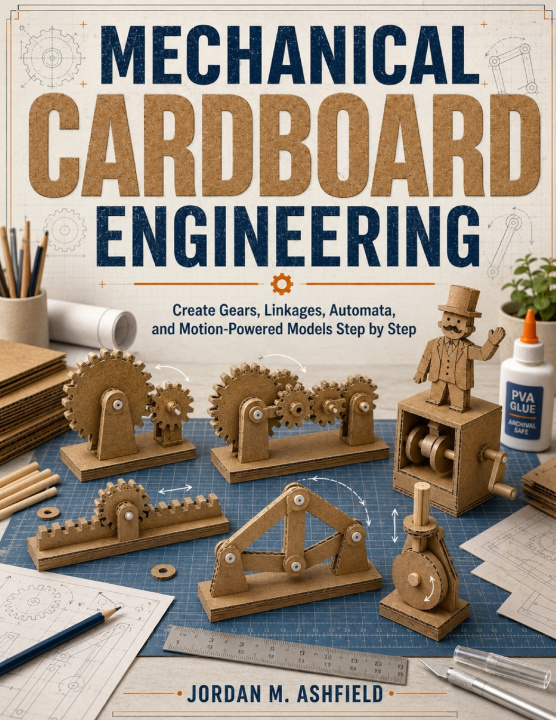
What if a sheet of cardboard could become a working machine?
Mechanical Cardboard Engineering shows you how to build moving mechanical models using ordinary cardboard, glue, dowels, craft tools, and careful construction methods. Instead of relying on electronics, 3D printing, or expensive shop equipment, this book teaches the physical logic of motion through hands-on projects that turn simple materials into gears, linkages, cams, cranks, and automata.
Inside, you will learn how to choose the right cardboard grades, cut and laminate accurate parts, reduce friction, align axles, build reliable pivots, and diagnose common problems such as binding, backlash, skipping gears, warped parts, and worn bearing holes. The early chapters explain how mechanisms work, including mechanical advantage, force transmission, kinematic diagrams, tolerances, clearances, gear ratios, linkage geometry, cam profiles, and automata construction.
The project section includes 21 graded builds organized by mechanism family. You will create spur-gear systems, compound gear trains, rack-and-pinion motion, bevel-drive steering, worm gear lifting, flapping wings, slider-crank piston motion, scissor lifts, pantographs, walking linkages, nodding figures, intermittent feeders, multi-cam stages, indexing wheels, animated characters, rowing scenes, a planetary orrery, and a Theo Jansen-inspired walking creature.
Each project is designed to teach a mechanical principle while producing a finished working model. Clear material guidance, structured steps, troubleshooting support, and template references help you build with confidence and understand why each mechanism works.
Whether you are a maker, teacher, hobbyist, designer, model builder, or engineering-curious creative, this book offers a practical path into mechanical thinking through one of the most accessible materials available: cardboard.