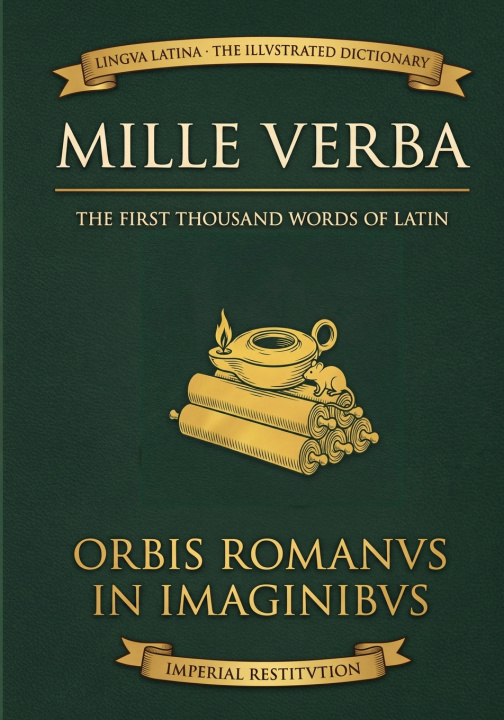
Your first thousand Latin words in beautiful pictures.
Open this book to any page and you are standing inside Rome: a bath-house where a thief is making off with someone's tunic, a chariot crash at the Circus Maximus, a shipyard, a school, a children's courtyard game of hoops and knucklebones. Thirty-five full-page engraved plates, drawn in the manner of the great eighteenth-century encyclopedias - and every object, person, and action in them numbered and named in Latin.
This is a picture dictionary in the tradition of Comenius' famous Orbis Pictus - reborn for the modern learner of Latin:
- 35 engraved plates of Roman daily life, every detail numbered
- 1,800 words - the core vocabulary of Caesar, Ovid, Vergil, and Pliny - each explained in easy Latin, never in English
- Closed vocabulary: every word used in a definition has its own entry in the book. You are never sent outside the thousand words.
- Real Latin under every entry: authentic lines from Ovid, Vergil, Pliny the Younger, and Caesar show each word in the wild
- SIM / CONTR cross-references, a full grammar reference chapter (pronouns, prepositions, conjunctions, numerals), and a complete alphabetical index mapping every word to its plate
- A hidden mouse in every plate. Thirty-five plates, thirty-five mice. Good luck.
Where do the thousand words come from?By combining three lists: First, the base vocabulary of Ørberg's beloved
Lingua Latina per se Illustrata - if you are reading (or about to read)
Familia Romana, you are already at home here. Second, the classic "first thousand words" lists behind the world's great picture dictionaries - house and body, food and animals, street and harbor: the things you can point at, in any language. Third, the working vocabulary of the authors of the extended Lingua Latina series and its books: Caesar, Ovid, Vergil, and Pliny the Younger. Where the three lists agree, a word's place was certain; where they differ, we kept what a learner meets again and again in real Latin. The count is close to 1,800 - "mille" is the Romans' own round number:
mille basia, mille colores, mille domos.Thus you won't need a dictionary and everything is explained in Latin itself: the pictures do the teaching, the way words were always meant to be learned. Perfect for homeschool families, self-taught learners, classical schools, and anyone beginning the Lingua Latina series - the reader series (Frontinus, Caesar, Ovid, Vergil, Pliny) is built on exactly the vocabulary taught in this volume.
Orbis Rōmānus, in tabulīs pictus, mīlle verbīs nārrātus.