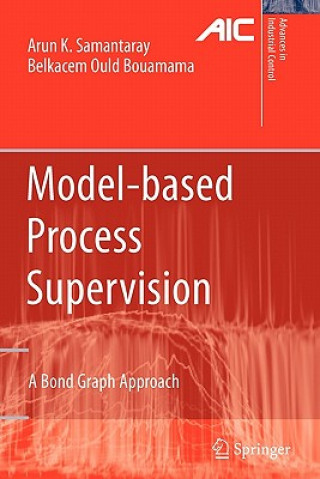
Könyv Model-based Process Supervision Arun Kumar Samantaray

Model-based Process Supervision

A Bond Graph Approach

Nyelv: Angol
Kötés: Puha kötésű
Elérhetőség: Beszállítói készleten alacsony példányszámban
Küldés 13-18 napon belül
61 970 Ft
Model-based fault detection and isolation requires a mathematical model of the system behaviour. Mod...


Információk a könyvről

Nyelv
Angol
Kötés
Könyv - Puha kötésű
Kiadva
2010
oldal
474
EAN
9781849967396
ISBN
1849967393
Enbook ID
01434644
Súly
753
Méretek
155 x 235 x 25

Teljes leírás

Model-based fault detection and isolation requires a mathematical model of the system behaviour. Modelling is important and can be difficult because of the complexity of the monitored system and its control architecture. The authors use bond-graph modelling, a unified multi-energy domain modelling method, to build dynamic models of process engineering systems by composing hierarchically arranged sub-models of various commonly encountered process engineering devices. The structural and causal properties of bond-graph models are exploited for supervisory systems design. §The structural properties of a system, necessary for process control, are elegantly derived from bond-graph models by following the simple algorithms presented here. Additionally, structural analysis of the model augmented with available instrumentation indicates directly whether it is possible to detect and/or isolate faults in some specific sub-space of the process. Such analysis aids in the design and resource optimization of new supervision platforms. §Static and dynamic constraints, which link the time evolution of the known variables under normal operation, are evaluated in real time to determine faults in the system. Various decision or post-processing steps integral to the supervisory environment are discussed in this monograph; they are required to extract meaningful data from process state knowledge because of unavoidable process uncertainties. Process state knowledge has been further used to take active and passive fault accommodation measures. §Several applications to academic and small-scale-industrial processes are interwoven throughout. Finally, an application concerning development of a supervision platform for an industrial plant is presented with experimental validation. §Model-based Process Supervision provides control engineers and workers in industrial and academic research establishments interested in process engineering with a means to build up a practical and functional supervisory control environment and to use sophisticated models to get the best use out of their process data.This book provides control engineers and workers in industrial and academic research establishments interested in process engineering with a means to build up a practical and functional supervisory control environment and to use sophisticated models to get the best use out of their process data. Several applications to academic and small-scale-industrial processes are discussed and the development of a supervision platform for an industrial plant is presented.Model-based fault detection and isolation requires a mathematical model of the system behaviour. Modelling is important and can be difficult because of the complexity of the monitored system and its control architecture. The authors use bond-graph modelling, a unified multi-energy domain modelling method, to build dynamic models of process engineering systems by composing hierarchically arranged sub-models of various commonly encountered process engineering devices. The structural and causal properties of bond-graph models are exploited for supervisory systems design. §The structural properties of a system, necessary for process control, are elegantly derived from bond-graph models by following the simple algorithms presented here. Additionally, structural analysis of the model, augmented with available instrumentation, indicates directly whether it is possible to detect and/or isolate faults in some specific sub-space of the process. Such analysis aids in the design and resource optimization of new supervision platforms. §Static and dynamic constraints, which link the time evolution of the known variables under normal operation, are evaluated in real time to determine faults in the system. Various decision or post-processing steps integral to the supervisory environment are discussed in this monograph; they are required to extract meaningful data from process state knowledge because of unavoidable process uncertainties. Process state knowledge has been further used to take active and passive fault accommodation measures. §Several applications to academic and small-scale-industrial processes are interwoven throughout. Finally, an application concerning development of a supervision platform for an industrial plant is presented with experimental validation. §Model-based Process Supervision provides control engineers and workers in industrial and academic research establishments interested in process engineering with a means to build up a practical and functional supervisory control environment and to use sophisticated models to get the best use out of their process data.

Érdekelheti

Roots of Lyric

Andrew Welsh
61 402 Ft

Jewish Game Changers

Diane A McNeil
7 708 Ft
5 210 Ft

The Book of the Truth Behind the Story

Ltd Publications International
5 138 Ft
5 975 Ft
5 935 Ft

AWWA B703-19 Fluorosilicic Acid

American Water Works Association
56 760 Ft
7 623 Ft

Alien Rebel's Bride

Taylor Neptune
4 015 Ft

Aaertwen

Ria Skelton
2 498 Ft

Functional C#

Wisnu Anggoro
14 422 Ft

Yaxchilan

Carolyn E. Tate
18 365 Ft

Azok a vásárlók, akik ezt a könyvet megvásárolták, a következőket is megvásárolták

4 100 Ft

Hitman. Tom 3

Garth Ennis
10 062 Ft

Nábřeží

Jiří Michálek
340 Ft
24 170 Ft

Kirmizi Paletli Timsah

Aysun Berktay Özmen
3 433 Ft
3 138 Ft
4 288 Ft
5 197 Ft