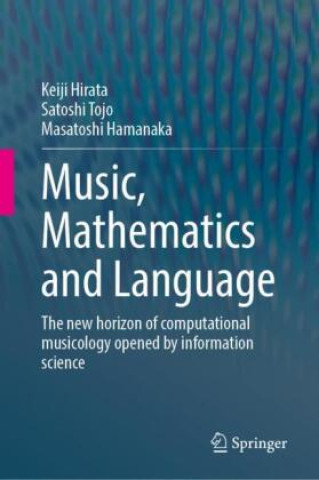
Könyv Music, Mathematics and Language Keiji Hirata

Music, Mathematics and Language

The New Horizon of Computational Musicology Opened by Information Science

Nyelv: Angol
Kötés: Kemény kötésű
Elérhetőség: Beszállítói készleten
Küldés 10-13 napon belül
70 894 Ft
This book presents a new approach to computational musicology in which music becomes a computational...

Információk a könyvről

Nyelv
Angol
Kötés
Könyv - Kemény kötésű
Kiadva
2022
oldal
257
EAN
9789811951657
Enbook ID
39442458
Súly
626
Méretek
155 x 235 x 20

Teljes leírás

This book presents a new approach to computational musicology in which music becomes a computational entity based on human cognition, allowing us to calculate music like numbers. Does music have semantics? Can the meaning of music be revealed using symbols and described using language? The authors seek to answer these questions in order to reveal the essence of music. Chapter 1 addresses a very fundamental point, the meaning of music, while referring to semiotics, gestalt, Schenkerian analysis and cognitive reality. Chapter 2 considers why the 12-tone equal temperament came to be prevalent. This chapter serves as an introduction to the mathematical definition of harmony, which concerns the ratios of frequency in tonic waves. Chapter 3, "Music and Language," explains the fundamentals of grammar theory and the compositionality principle, which states that the semantics of a sentence can be composed in parallel to its syntactic structure. In turn, Chapter 4 explains the most prevalent score notation - the Berklee method, which originated at the Berklee School of Music in Boston - from a different point of view, namely, symbolic computation based on music theory. Chapters 5 and 6 introduce readers to two important theories, the implication-realization model and generative theory of tonal music (GTTM), and explain the essence of these theories, also from a computational standpoint. The authors seek to reinterpret these theories, aiming at their formalization and implementation on a computer. Chapter 7 presents the outcomes of this attempt, describing the framework that the authors have developed, in which music is formalized and becomes computable. Chapters 8 and 9 are devoted to GTTM analyzers and the applications of GTTM. Lastly, Chapter 10 discusses the future of music in connection with computation and artificial intelligence.This book is intended both for general readers who are interested in music, and scientists whose research focuses on music information processing. In order to make the content as accessible as possible, each chapter is self-contained.

Érdekelheti

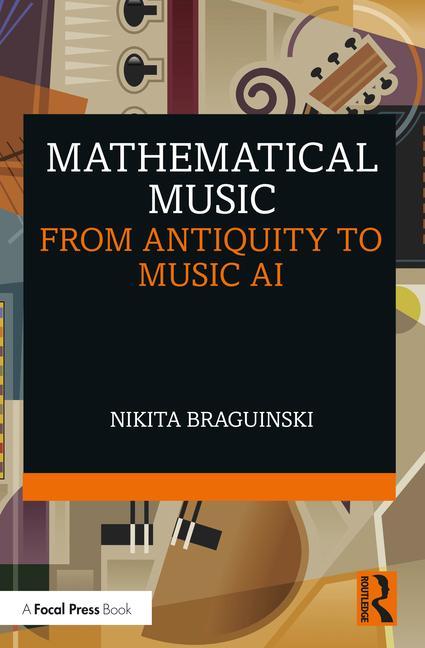
Mathematical Music

Nikita Braguinski
20 152 Ft
24 069 Ft
39 428 Ft

Geometry of Music

Dmitri Tymoczko
41 365 Ft
4 004 Ft
5 418 Ft

Asemic

Peter Schwenger
11 240 Ft

Preface to Religion

Fulton J. Sheen
4 734 Ft
10 804 Ft

Horny Wife

Heidi Deepkiss
3 260 Ft
14 982 Ft

Azok a vásárlók, akik ezt a könyvet megvásárolták, a következőket is megvásárolták

Auf dem Jakobsweg

Paulo Coelho
4 541 Ft
7 323 Ft
4 004 Ft
7 062 Ft

Numerologie

Gabriele Köstinger
2 677 Ft

Zornpolitik

Uffa Jensen
5 928 Ft

Shotcrete

Marc Jolin
32 292 Ft

Arrojar piedras

Javier Pérez Walias
5 051 Ft
5 579 Ft

Jak jsem se zbláznila

Ivanka Devátá
3 829 Ft
3 118 Ft
5 693 Ft