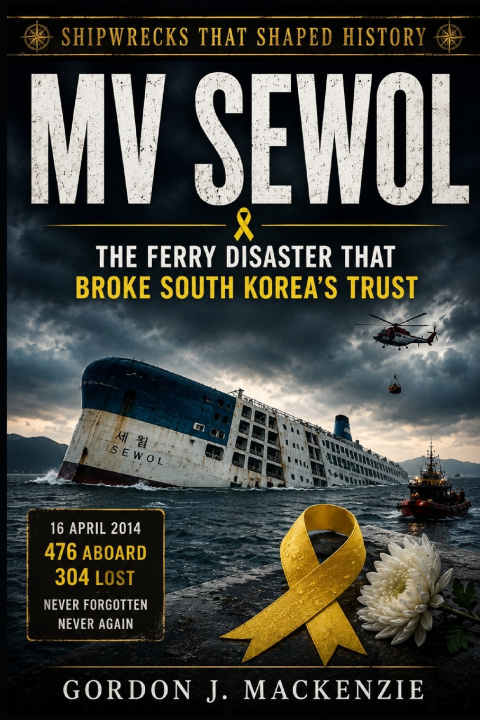
On 16 April 2014, the passenger ferry MV Sewol began to list during a routine voyage from Incheon to Jeju. Hundreds of passengers, including students travelling on a school excursion, were told to remain where they were.
By the time the full danger became clear, escape routes were disappearing.
Of the 476 people aboard, 304 lost their lives. Most of the victims were students from Danwon High School. Their deaths transformed a maritime disaster into a national reckoning over safety, authority, rescue, accountability and public trust.
This book reconstructs the complete history of the Sewol disaster. It examines the ferry's modification and operation, dangerous loading practices, reduced stability, unsecured cargo, the fatal turn, the failure to order an immediate evacuation and the conduct of the captain and crew. It also investigates why the rescue response failed to save hundreds of people trapped inside a vessel that remained visible from the surface.
The sinking did not end when Sewol disappeared beneath the water. Families demanded the recovery of the dead, criminal trials brought partial accountability, and the yellow ribbon became a lasting symbol of remembrance, protest and the refusal to accept official silence.
MV Sewol is a respectful and unsparing account of a preventable catastrophe that exposed failures throughout a modern transport and emergency-response system. It explains not only how a ferry sank, but why the disaster shattered South Korea's confidence in the institutions that were supposed to protect its citizens.