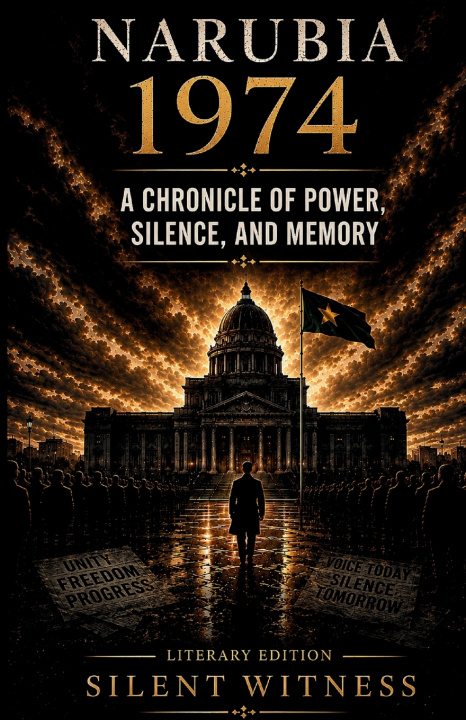
A nation can lose its freedom without ever announcing the loss.
In 1974, Narubia raises its flag and enters independence with hope, pride, and the promise of self-rule. Beneath the celebration, however, a constitutional compromise is quietly filed-one sentence that will shape the republic for generations.
What follows is not the story of a sudden dictatorship. It is the story of how power becomes ordinary.
Through the lives of Elias Daro, his daughter Mara, her son Kalen, and the generations that follow, Narubia 1974 traces the slow transformation of a young republic. Courts continue to sit. Parliament continues to meet. Elections continue to be held. Yet, year by year, institutions lose their ability to restrain power.
Silence becomes protection. Loyalty becomes currency. Procedure becomes a weapon. Citizens learn to anticipate authority before authority speaks.
As Narubia moves from post-independence optimism to institutional capture, its methods of control also evolve. Paper files become databases. Informal observation becomes digital surveillance. A state once governed through offices, permits, and whispered warnings learns to follow its citizens through the systems designed to serve them.
When the political order finally fractures, collapse does not automatically produce freedom. The generations that inherit the ruins must confront exile, compromised memory, unfinished justice, and the danger that old powers may return disguised as reform.
One question remains:
Can a country that remembers oppression recognise it when it returns in the language of renewal?
Written as restrained, multigenerational political fiction, Narubia 1974 explores:
• Authoritarianism hidden inside ordinary administration
• The social cost of fear and self-censorship
• Manipulated elections and weakened institutions
• Corruption, loyalty, exile, memory, and resistance
• Digital surveillance and the modern architecture of control
• The difficult work of rebuilding a republic after power has hollowed it out
Narubia is not the history of one country. It is an invented republic assembled from political habits that have appeared across many societies. The novel follows one family through the quiet passage by which freedom becomes conditional, institutions become ceremonial, and survival begins to resemble consent.
For readers of literary political fiction, postcolonial fiction, African political literature, political dystopia, and multigenerational stories about power, memory, and national renewal.
Power does not arrive suddenly. It becomes normal.