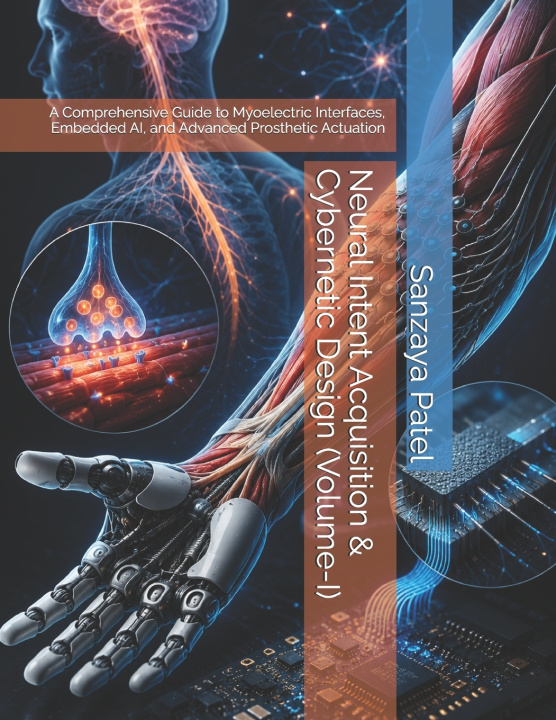
Before a prosthetic hand can move, before an AI can recognize intent, and before a robot can respond to human thought, a signal must first be captured.
Neural Intent Acquisition is the first volume of the Neural Intent Systems series, exploring the biological and engineering foundations of human-machine integration. From the motor cortex and corticospinal tract to electromyography, targeted muscle reinnervation, high-density EMG arrays, electrode design, analog front-end electronics, and cybernetic socket architectures, this volume provides a comprehensive roadmap for understanding how neural intent becomes measurable data.
Combining neuroscience, biomedical engineering, signal acquisition, physiology, and prosthetic technology, this book bridges the gap between human biology and modern cybernetic systems through rigorous technical explanations, practical engineering insight, and systems-level thinking.
Inside you'll discover:
• The complete neuromotor pathway from brain to muscle
• The physics of electromyography and volume conduction
• Biomechanics of the human hand and forearm
• Targeted Muscle Reinnervation (TMR) and surgical augmentation
• High-Density EMG acquisition systems
• Analog Front-End (AFE) design principles
• Electrode-Skin Interface engineering
• Invasive versus non-invasive neural interfaces
• Cybernetic socket architecture and structural integration
Whether you are developing advanced prosthetics, neural interfaces, wearable technologies, rehabilitation systems, or simply exploring the future of human augmentation, this volume provides the essential foundation.
The future of human-machine integration begins with understanding intent.