A signal is only the beginning.
Once biological intent has been captured, a far greater challenge emerges: transforming raw electrical activity into meaningful intelligence. Hidden within every biosignal are patterns, relationships, and temporal structures that reveal what a person intends to do-but extracting that information requires sophisticated computational methods capable of learning, adapting, and operating under uncertainty.
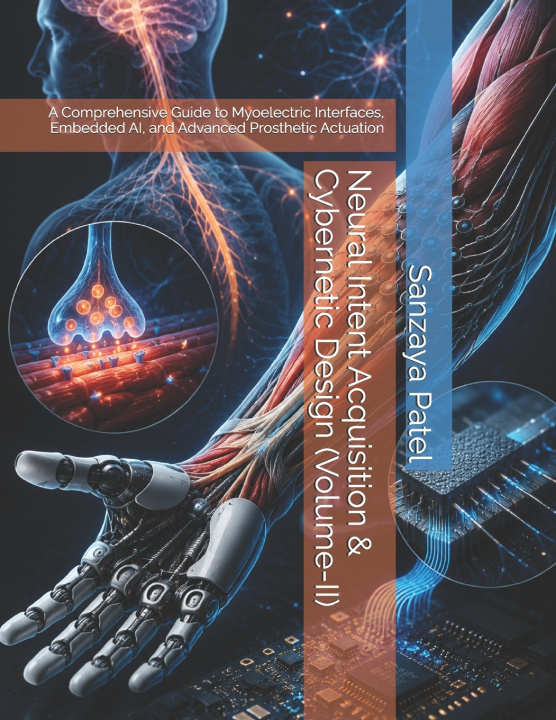
This is the second volume of the Neural Intent Systems series, exploring the algorithms, models, and machine learning architectures that convert biological signals into actionable predictions. Bridging signal processing, statistical learning, deep neural networks, adaptive systems, and embedded artificial intelligence, this volume provides a comprehensive framework for understanding how machines learn to interpret human intent.
Inside you'll discover:
• Digital signal processing and noise suppression techniques
• Feature extraction and representation learning
• Blind source separation and Independent Component Analysis (ICA)
• Statistical classification and pattern recognition systems
• Sim-to-Real transfer learning strategies
• Recurrent Neural Networks (RNNs) and temporal modeling
• Long Short-Term Memory (LSTM) architectures
• Attention mechanisms and sequence learning
• Quantization, pruning, and neural network optimization
• Edge AI deployment and embedded inference
• Online adaptation, robustness, and continual learning
Written from a systems-engineering perspective, this volume reveals the hidden intelligence layer that exists between biological signals and robotic action. It explains not only how machine learning models operate, but why they succeed, where they fail, and how they can be engineered to perform reliably in real-world human-machine interfaces.
Whether you are developing advanced prosthetics, rehabilitation technologies, wearable systems, neural interfaces, or next-generation AI applications, this book provides the tools required to transform raw data into understanding.
Because before a machine can act, it must first learn to understand.
Welcome to signal intelligence.