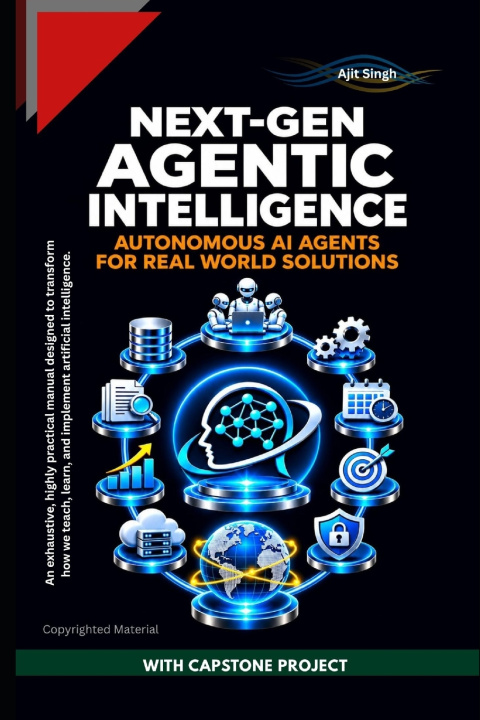
Next-Gen Agentic Intelligence is an exhaustive, highly practical manual designed to transform how we teach, learn, and implement artificial intelligence. Moving beyond the limitations of conversational chatbots, this book focuses entirely on autonomous agents: AI systems capable of reasoning, planning, utilizing external tools, and collaborating in multi-agent teams to solve complex enterprise problems.
Philosophy
The foundational philosophy of this book is strictly "Implementation Over Theory." While theoretical understanding is necessary, true mastery of computer science and artificial intelligence is achieved exclusively through the act of building. Current literature often strands readers in a sea of abstract mathematics or high-level conceptual diagrams, leaving them unequipped to design a system, write the code, and deploy it to a production server.
This book reverses that paradigm. Every concept is immediately anchored to a practical application. The philosophy is driven by the conviction that learning to build Next-Gen AI should be as logical and straightforward as building traditional software. By breaking down complex neural network behaviors into simple algorithmic steps, I demystified the "black box" of AI, making it accessible, engineerable, and deployable.
Key Features
1. 100% Practical Orientation: A relentless focus on how to implement and develop real-world apps/solutions.
2. From Scratch to Production: Covers the entire software development lifecycle (SDLC) for AI-design, build, setup, deployment, implementation, and production.
3. 2030 Syllabus Compatibility: Designed explicitly to meet the upcoming academic standards of leading international universities, making it the perfect textbook for next-generation computer science curricula.
4. Live Capstone Project: Chapter 10 provides a completely functional, multi-agent enterprise DIY project with full code and line-by-line explanations.
5. Industry Relevant: Focused entirely on current and future industry demands, prioritizing frameworks, cloud deployments, and CI/CD pipelines used by top tech firms.
Key Takeaways
1. Clearly define, classify, and differentiate Agentic AI from traditional LLMs and legacy software.
2. Translate complex business requirements into simple AI algorithms.
3. Design and build custom AI agents from scratch using prompt engineering, memory modules, and tool-calling capabilities.
4. Architect and deploy multi-agent swarms where AI "employees" (e.g., AI Coder, AI Reviewer, AI Manager) collaborate to solve enterprise-scale problems.
5. Set up secure, scalable deployment pipelines (CI/CD) to move agentic applications from local development environments to live production servers.
6. Implement robust safety, alignment, and security protocols to ensure autonomous agents operate within strictly defined enterprise boundaries.
Disclaimer: Earnest request from the Author.
Kindly go through the table of contents and refer kindle edition for a glance on the related contents.
Thank you for your kind consideration!