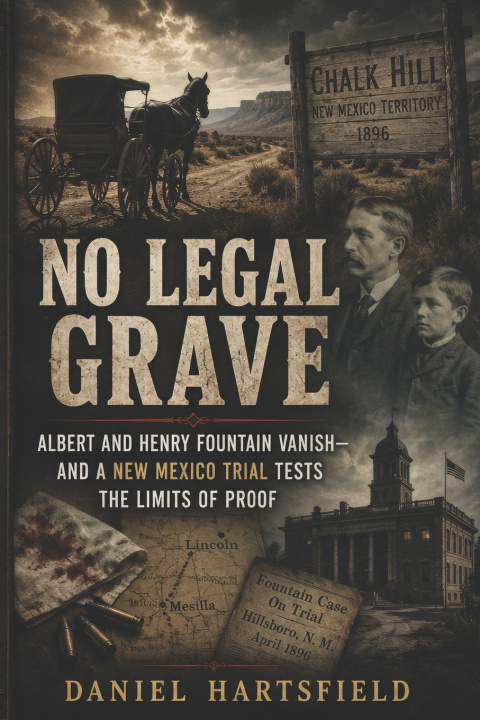
A father and son vanish on a New Mexico road-and the law must decide what absence can prove.
In 1896, lawyer and prosecutor Albert Jennings Fountain and his young son, Henry, disappeared while traveling by buckboard from Lincoln toward Mesilla in New Mexico Territory. Near Chalk Hill, searchers found signs suggesting violence: reported blood, spent cartridges, tracks, personal items, and an abandoned wagon. The bodies were never recovered.
No Legal Grave is a historical true crime narrative about the Fountain disappearance, the investigation that followed, and the Hillsboro trial that tested whether circumstantial evidence could support a murder conviction without recovered remains. It follows Albert's cattle-rustling prosecutions and political conflicts, the reported pursuit on the last road, the search toward Dog Canyon, and the pressure gathering around men who became subjects of public suspicion.
Pat Garrett, private investigators, warrants, a deadly confrontation at Wildy Well, witnesses, missing papers, and contested scene evidence all enter the record. So do the limits: no autopsy, no complete chain of custody, conflicting historical accounts, and testimony vulnerable to fear, loyalty, time, and territorial faction.
Oliver M. Lee and James Gililland were tried and acquitted. William McNew was not convicted. Albert B. Fall was never charged in the Fountain case. Rather than converting suspicion into certainty, the book separates documented legal status from allegation, public memory, interpretation, and rumor. It asks what a powerful theory means when a courtroom has tested it and returned no conviction.
At the center are Albert and Henry, and the family left without remains or a final answer. The case is examined not only as an Old West mystery but as a human loss shaped by cattle-country power, frontier law, politics, evidence, and the difference between grief and proof.
Written in a restrained, victim-centered, evidence-aware style, No Legal Grave reconstructs the disappearance, search, investigation, trial, acquittal, and long afterlife of an unresolved territorial New Mexico case. A timeline, key-people glossary, and source index help readers follow the record without mistaking unanswered questions for established fact.
For readers drawn to historical true crime, unsolved disappearances, no-body murder cases, Old West history, and courtroom nonfiction, this book examines what can be known, what was alleged, what failed under legal scrutiny, and what the desert never returned.