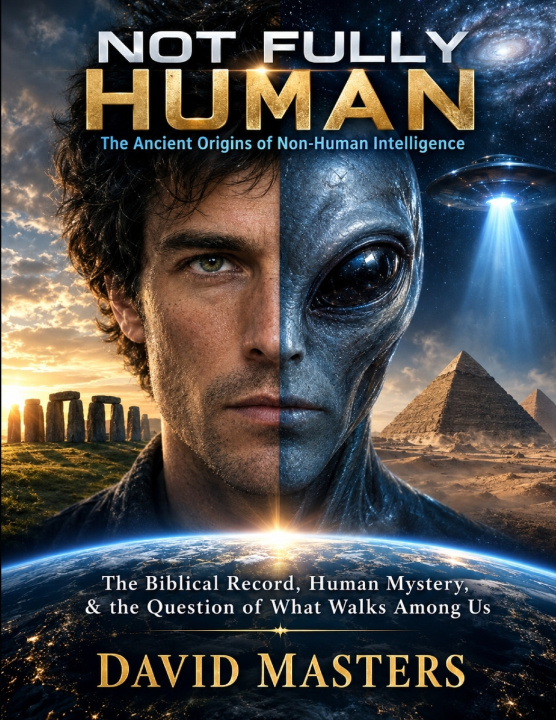
NOT FULLY HUMAN
Carl Sagan's Warning: When Technological Power Outpaces Human Understanding
Carl Sagan's The Demon-Haunted World: Science as a Candle in the Dark offers a powerful starting point for examining the central argument of Not Fully Human: humanity can develop extraordinary technological capabilities while losing the discernment necessary to understand the forces shaping its existence. Sagan was concerned with the erosion of scientific literacy, the manipulation of public understanding, the concentration of technological power, and the growing inability of ordinary people to distinguish evidence from comforting illusions. His warning was not simply about the future of science. It was about the future of human judgment.
Sagan wrote:
"I have a foreboding of an America in my children's or grandchildren's time - when the United States is a service and information economy; when nearly all the manufacturing industries have slipped away to other countries; when awesome technological powers are in the hands of a very few, and no one representing the public interest can even grasp the issues; when the people have lost the ability to set their own agendas or knowledgeably question those in authority; when, clutching our crystals and nervously consulting our horoscopes, our critical faculties in decline, unable to distinguish between what feels good and what's true, we slide, almost without noticing, back into superstition and darkness."
He continued with this observation about the condition of American culture:
"The dumbing down of America is most evident in the slow decay of substantive content in the enormously influential media, the 30 second sound bites (now down to 10 seconds or less), lowest common denominator programming, credulous presentations on pseudoscience and superstition, but especially a kind of celebration of ignorance."
These words, published in 1995, take on additional significance in an age of artificial intelligence, algorithmically curated information, ubiquitous smartphones, digital surveillance, and increasingly sophisticated systems capable of influencing what people see, believe, and desire. Yet the deeper concern is not the machinery itself. Technology is a delivery system. The decisive question is what uses that system, what purposes it serves, and whether the people subjected to its influence possess the awareness to recognize what is happening.
Not Fully Human approaches this problem from a broader philosophical and spiritual perspective.
It asks whether the human environment may involve influences that cannot be adequately understood by looking at technological mechanisms alone. It examines the possibility of nonhuman intelligence, ancient accounts of the Watchers, and the recurring human experience of encountering something perceived as operating beyond ordinary human motives and understanding. These subjects require careful distinctions between documented evidence, historical interpretation, religious tradition, and speculation. But asking difficult questions is not the same as claiming certainty, and refusing to examine a possibility is not the same as disproving it.
Sagan's work provides a useful intellectual discipline for this investigation: resist both automatic belief and automatic dismissal. The objective is neither to accept every extraordinary claim nor to assume that conventional explanations have already answered every important question. It is to preserve the capacity to investigate, compare evidence, recognize uncertainty, and question the authority of anyone who demands unquestioning allegiance.