In the spring of 1973, a teacher in a Lincoln, Nebraska classroom handed an eight-year-old boy a blue armband marked S, for slave, and set the brown-eyed children over him for the day. The next morning the roles reversed. No one in that room was Black. The lesson, the teacher said, was empathy.
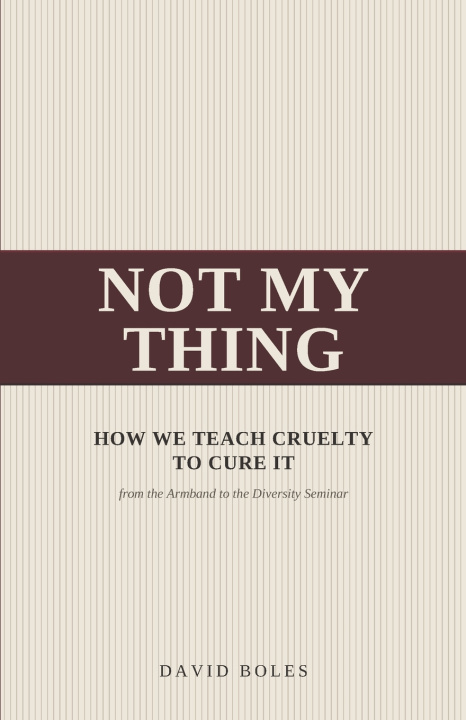
Not My Thing is the case against that lesson and the whole family of exercises bred from it: the eye-color demonstration, the privilege walk, the poverty simulation, the mock slave auction, the scared-straight tour, the Gestapo role-play, the mandatory diversity seminar. David Boles argues that these rituals, however different their politics, run on a single machine. Caste assigned by accident. An authority no one may refuse. Cruelty licensed from the front of the room. An audience for whom the humiliation is performed. A reversal that exposes the whole thing as a performance the authority could switch off. It is the method of the oppressor, and it trains submission to cruelty whatever cause it claims to serve.
Drawing on the documented record and on the research that went back to the famous experiments and found them wanting, Boles presses three charges. A coercive method teaches its own lesson regardless of its goal. The empathy exercise often hardens the attitudes it sets out to soften, an injury caused by the treatment itself. And each of these rituals depends on the absence of the people it claims to be about, collapsing the moment one of them is in the room.
The book is hard on a method and loyal to its goal, and it holds the two apart on every page. The cure it offers is quieter and slower than one vivid afternoon of role-play, and it begins where the book begins, with an eight-year-old's refusal to wear the band.