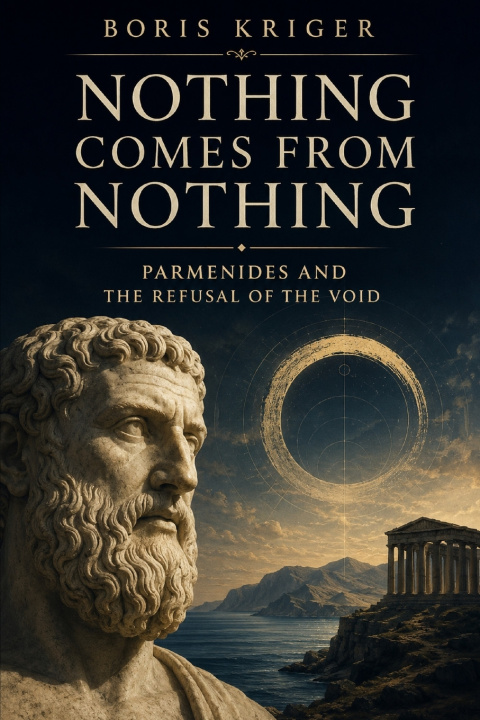
Everyone thinks they know Parmenides. He was the odd man of ancient Greece who used cold logic to prove that motion is impossible, that change is a fraud, and that your own eyes are liars. He is the philosopher common sense loves to hate, filed away as a curiosity between two more agreeable neighbors. This book argues that almost everything in that portrait is upside down, and that the real Parmenides was not the enemy of the living world but its unlikeliest comforter.
Twenty-five centuries ago, a man from a small Greek colony in southern Italy became the first person in the West to reason carefully about the strangest fact there is: that anything exists at all. What he found beneath the flicker of the visible world was something that could not be born and could not die, because the only alternative to being is a nothing that cannot even be thought. There is no edge to fall off. There is no void waiting on the other side of things. Nothing comes from nothing, and nothing ever returns to it, for the simple reason that nothing was never an option.
Written without a single equation and in a voice that is by turns wry, humane, and quietly astonished, this book walks down from that discovery into the places where it actually matters - grief, mortality, identity, wonder - and follows its long afterlife from Zeno's paradoxes and Plato's most difficult dialogue to Einstein's frozen universe and the charred scrolls now being read by machines beneath the ash of Vesuvius. It is a companion to the author's study of Heraclitus, and its final claim is that the two most opposed thinkers in history were describing one world from two ends: the river flows, and it flows upon a bed that does not move.
A book for anyone who has ever feared that they are slipping away, and wanted a reason, rather than a reassurance, to believe otherwise.
Keywords: Parmenides, being, nothingness, metaphysics, presocratic philosophy, time, mortality