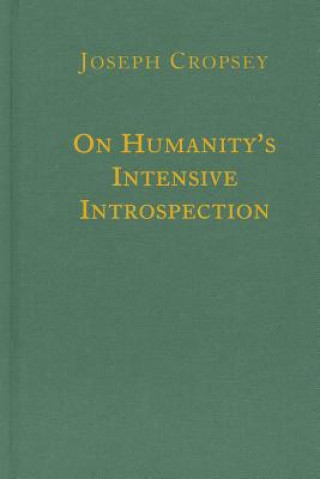
The essays and lectures first collected here span a period of over 25 years and cover the greater part of Joseph Cropsey’s illustrious career of scholarship and teaching at the University of Chicago. They are presented in the order in which he wrote them. The central problem of human thought and existence, according to Cropsey, is that it is absolutely impossible for a human being to understand his human condition without understanding his position within the whole of which the human is only a part. Our imperfect knowledge of the whole therefore places limits on our knowledge of ourselves, for we do not know where we stand in relation to the whole that conditions us, and therewith our own condition. What then should we do in the face of our irremediable ignorance and uncertainty? Cropsey argues that the difficulties currently faced by liberalism arise from the efforts of later thinkers to elevate it beyond its Hobbesian origins in self-preservation and natural necessity. As a result of their flights from nature to morality, the sovereignty that for Hobbes protected natural rights decayed into a mere legalism that undermines liberalism’s ability to defend itself. Cropsey explores the tendencies within liberalism toward both self-abnegation and self-assertion as well as the resources in the Western tradition that can help fortify contemporary liberalism. Both Scripture and Plato, for example, insist that our “flights from nature” remain cognizant of human limitation. And the robust strands of modernity, found in the works of Locke and Smith as well as of Hobbes, demonstrate the benefits of a freedom within the limits of nature. In contrasting liberal democracy and Marxism – the version of modern politics that best exemplifies the flight from nature – Cropsey finds that liberal democracy manifests a spirited animus against being ruled by others, and celebrates individual choice, whereas Marxism allows a freedom to will only the rational, as it emerges in history, and aspires to replace the competitiveness of bourgeois life with an affectionate sociability. Cropsey also shows how liberalism’s separation of church and state, which replaces Hobbes’ teaching on sovereignty, serves in fact to protect civil supremacy by limiting religious authority to the private sphere at the same time that it moderates the state by depriving it of any claim to divine support. But he warns against the complacency implied in the thesis that liberal democracy represents the end or culmination of history. Looking further at the resources within the tradition that might strengthen contemporary liberalism, Cropsey challenges not merely orthodoxies of Platonic scholarship, but the very distinction between ancients and moderns, the identification of philosophy with reason, and ultimately the dichotomy between reason and revelation. Cropsey’s equating the meaning of an open society with openness to the activity of philosophy within it might appear to be in tension with Plato’s famous description in the Republic of a closed society ruled by philosopher-kings. But Cropsey shows that in the Timaeus, which provides a cosmological setting for the activity of the Republic’s city, Plato himself questions the intelligibility of the whole. In his analysis of Plato’s Philebus Cropsey emphasizes the disjunction between the finite, intelligible and infinite, unintelligible elements.. The inscrutability of the whole connects philosophy to revelation as well as philosophy’s political activity to an open or liberal society. Crospey’s essays represent experiments in philosophic interpretations of our world, which draw on the political and philosophical thought that has helped to form that world and that help us to evaluate our strengths and weaknesses in light of our essential humanity.