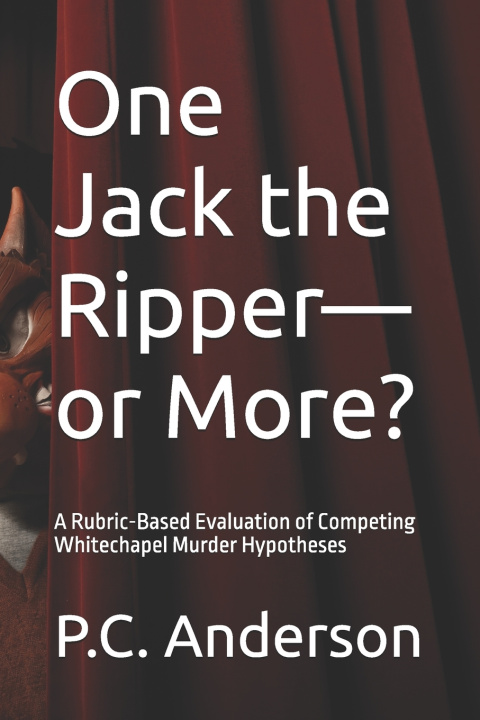
For over a century, the legend of Jack the Ripper has rested on a powerful assumption: that one man committed the five canonical Whitechapel murders of 1888. This book challenges that foundation with a fresh, evidence-based approach. Rather than inheriting the single-offender narrative, it systematically tests alternative hypotheses using the Suspect Viability & Vulnerability Rubric (SVVR)-a transparent, 10-variable framework designed to evaluate suspects and crime clusters with consistency.
Building on the author's previous volume, which scored twelve suspects under the traditional model, this sequel asks: What if the canonical five were not the work of one hand? Could Mary Jane Kelly's horrific indoor murder have been a domestic tragedy? Was Elizabeth Stride's death an interrupted attack or unrelated killing? Might the mutilation cases belong to one offender, while other murders reflect opportunistic or personal violence? Or was "Jack the Ripper" largely a media construct born of sensational press coverage and public fear?
Through detailed case-by-case analysis, the book examines five competing hypotheses:
H₁: Single Offender - the traditional view.
H₂: Kelly Distinct - her murder as a personal/domestic act.
H₃: Stride Outlier - an interrupted or unrelated killing.
H₄: Multiple Offenders - two or more perpetrators.
H₅: Media Construct - the "Ripper" label as press invention.
Each chapter re-applies SVVR variables-geographic opportunity, behavioral consistency, anatomical capability, witness alignment, and investigative weight-to victim clusters and suspects. The result is a comparative map of how well different models fit the evidence. Where records are thin, the limitations are openly acknowledged; where modern claims (DNA on letters, royal conspiracies) fail scrutiny, their weaknesses are exposed.
Far from diminishing the horror of the crimes, this approach honors the individuality of each victim. By disaggregating the murders, the book highlights differences in setting, mutilation, and motive that may have been obscured by the single-killer narrative. Readers are invited to apply the rubric themselves, seeing exactly where the evidence converges-or diverges.
Key Features:
A groundbreaking application of criminological linkage analysis to the Whitechapel murders.
Transparent scoring of suspects and scenarios using the SVVR framework.
Balanced consideration of both single-offender and multi-offender models.
Clear, structured prose that respects both scholarly rigor and accessibility.
A challenge to inherited assumptions, encouraging intellectual honesty in historical crime analysis.
Whether you are a seasoned Ripperologist, a student of criminology, or simply fascinated by Victorian history's most enduring mystery, One Jack the Ripper-or More? offers a compelling, methodical exploration of the evidence. It does not claim to solve the case-but it does insist on asking the right questions.