Twenty-two years before Congress ever argued about how thirteen colonies should become one country, the same argument had already happened once - and failed completely.
In 1754, Benjamin Franklin brought a plan for colonial union to a room in Albany, New York. Every delegate present signed off on it. Every colonial assembly that received it afterward rejected it outright. Franklin filed the failure away and, decades later, helped write the version that actually stuck. He never fully stopped wondering whether the first draft might have spared everyone the war it took to get to the second one.
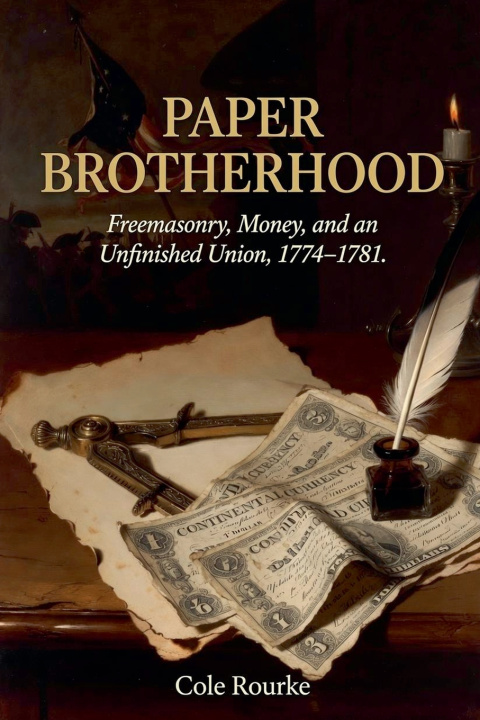
Paper Brotherhood picks up that unfinished argument and follows it through the years most histories skip past - not the drama of 1776, but the harder, messier work of actually trying to govern afterward. A Congress with no constitution of its own, printing money backed by nothing, while thirteen separate colonies argued for years over whose western land claims counted and whose didn't. Land companies with overlapping investors buying the same disputed territory twice. A currency that collapsed so completely the phrase "not worth a Continental" outlived the war that caused it. A document - the Articles of Confederation - drafted in weeks and then left to sit unratified for years, held hostage by a single state's refusal to sign until the states with the biggest western land claims agreed to give some of it up.
Running underneath all of it is a fraternity that mirrored the country's own problem exactly: thirteen colonies, thirteen separate Masonic Grand Lodges, and no continental one - brothers everywhere, no actual brotherhood binding them together, any more than the states themselves were bound. This book checks every Masonic claim in these pages against the same standard the rest of the Founders Trilogy uses: documented is documented, disputed is called disputed, and a good story is never allowed to stand in for a lodge record it doesn't have.
Some of the men in these pages used Masonic trust as real leverage in a financial scheme. One was accused, credibly, of betraying it outright. The book names both without flinching and without pretending either case is simpler than the evidence actually allows.
This isn't a book about a Congress moving in a straight line from grievance to government. It's about mutinies in the snow, secret diplomatic channels working at cross purposes with each other, a valley sold twice over by two different colonies, and a union that took thirty-three years and five separate serious attempts to even partially work - the first of them Franklin's own, in a room in Albany nobody remembers, twenty-two years before anyone thought to try again.
Every claim here is checked against the historical record and against itself. Disputed evidence is called disputed. Uncomfortable facts are never softened into comfortable ones.
Book Three of the Founders Trilogy. Start with Independence Masons or Brothers of the Convention, or begin here - Paper Brotherhood stands entirely on its own.