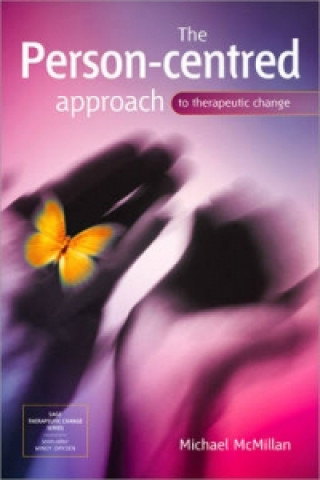
Könyv Person-Centred Approach to Therapeutic Change Michael McMillan

Person-Centred Approach to Therapeutic Change

Szerző: Michael McMillan
Nyelv: Angol
Kötés: Puha kötésű
Elérhetőség: Beszállítói készleten
Küldés 14-20 napon belül
13 887 Ft
From the Foreword 'It is an honour to be asked to write a foreword for this new book by Michael McMi...

Információk a könyvről

Nyelv
Angol
Kötés
Könyv - Puha kötésű
Kiadva
2004
oldal
104
EAN
9780761948698
ISBN
0761948694
Enbook ID
04156549
Súly
142
Méretek
142 x 216 x 7

Teljes leírás

From the Foreword 'It is an honour to be asked to write a foreword for this new book by Michael McMillan. I have been excited about this book ever since I read early drafts of its first two chapters some time ago at the birth of the project. At different times thereafter I have read other parts and my consistent impression has been that this is an author who has both a sophisticated academic understanding of the material and a great skill in communicating that widely. Those two qualities do not often go together! The book is about change. After a first chapter in which the author introduces us to the person-centred concept of the person, chapter two is devoted to the change process within the client, including a very accessible description of Rogers' process model. Chapter three goes on to explore why and how change occurs in the human being, while chapter four introduces the most up-to-date person-centred theory in relation to the nature of the self concept and its changing process.Chapters five and six explore why change occurs in therapy and the conditions that facilitate that change, while chapter seven looks beyond the core conditions to focus on the particular quality of presence, begging the question as to whether this is a transpersonal/transcendental quality or an intense experiencing of the core conditions themselves. This is an intensely modern book particularly in its postmodern emphasis. Rogers is sometimes characterised as coming from modernist times but he can also be seen as one of the early post modernists in his emphasis on process more than outcome and relationship more than personal striving. The modern nature of the book is also emphasised by a superb analysis of the relationship between focussing and person-centred therapy in Chapter five, linking also with Polanyi's notion of indwelling in this and other chapters. In suggesting that in both focussing and person-centred therapy the therapist is inviting the client to 'indwell' himself or herself, the author provides a framework for considering many modern perceptions of the approach including notions such as 'presence' and ' relational depth'.Also, the link with focussing is modern in the sense that the present World Association for the approach covers a fairly broad family including traditional person-centred therapists, experiential therapists, focussing-oriented therapists and process-guiding therapists. Important in this development is the kind of dialogue encouraged by the present book' - Dave Mearns, Strathclyde University The belief that change occurs during the therapeutic process is central to all counselling and psychotherapy. The Person-Centred Approach to Therapeutic Change examines how change can be facilitated by the counsellor offering empathy, unconditional positive regard and congruence. The Person-Centred Approach to Therapeutic Change outlines the main theoretical cornerstones of the person-centred approach and then, applying these, describes why change occurs as a result of a person-centred therapeutic encounter. The author explores the counselling relationship as an environment in which clients can open themselves up to experiences they have previously found difficult to acknowledge and to move forward.Integral to the person-centred approach is Carl Rogers' radical view that change should be seen as an ongoing process rather than an alteration from one fixed state to another. In Rogers' view psychological health is best achieved by the person who is able to remain in a state of continual change. Such a person is open to all experiences and is therefore able to assimilate and adapt to new experiences, whether 'good' or 'bad'. By focusing explicitly on how change is theorized and facilitated in counselling, this book goes to the heart of person-centred theory and practice, making it essential reading for trainees and practitioners alike.

Érdekelheti

Be a Good Girl

Tess Diamond
2 996 Ft

Kelly's Pocket Posh Journal, Tulip

Andrews McMeel Publishing
2 996 Ft

Code of Ethics for Nurses

American Nurses Assn
19 597 Ft
11 854 Ft
39 576 Ft
3 595 Ft
3 945 Ft

He Found Me

Whitney Barbetti
4 471 Ft

We

Yevgeny Zamyatin
3 494 Ft
3 305 Ft

Morgan's Reading Log

Martha Day Zschock
6 139 Ft
24 261 Ft
4 120 Ft
6 139 Ft
7 250 Ft

Azok a vásárlók, akik ezt a könyvet megvásárolták, a következőket is megvásárolták

2 996 Ft
1 097 Ft

Giselle, la amante del inquisidor

Por El Espíritu Leonel
10 697 Ft

Le Jeu De Stratégie: Ou, Les Échecs Militaires...
Armand Charles Daniel Firmas Périès (c
11 693 Ft

Lorca + CD

Aroa Moreno Durán
4 517 Ft

GER-NACHGELASSENE BRIEFE UND S

Ferdinand 1825-1864 Lassalle
13 854 Ft
3 871 Ft

Wapiti!

Christiane Duchesne
8 637 Ft
10 697 Ft

ELE y la web social

Pilar Concheiro Coello
6 853 Ft