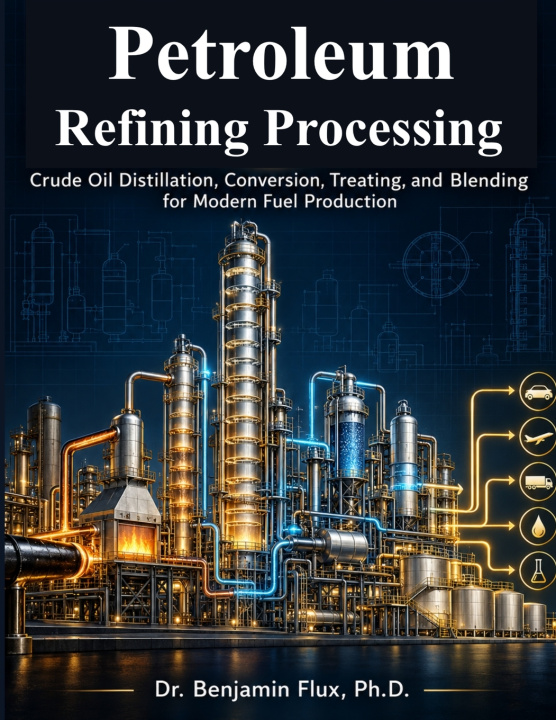
Petroleum Refining Processing is a comprehensive, technically rigorous guide to the engineering principles and process systems that transform crude oil into specification-grade fuels and petroleum products. Designed for upper-level engineering students, early-career process engineers, refinery personnel, and technical professionals, the book explains petroleum refining as an integrated system rather than a collection of isolated unit operations. Petroleum Refining
Beginning with the nature and variability of crude oil, the book develops a clear understanding of the four fundamental refinery operations-separation, conversion, treating, and blending-and shows how they work together to convert raw crude into gasoline, jet fuel, diesel, lubricant base stocks, light gases, petrochemical feedstocks, and other marketable products. Petroleum Refining
Readers are guided through the logic of refinery configuration, crude distillation, catalytic conversion, hydroprocessing, product treating, blending, utilities, safety, environmental considerations, and refinery economics. The emphasis throughout is on understanding what each process accomplishes, why it is required, how it operates, and how it connects with the rest of the refinery. Equations are introduced from clearly stated assumptions, while worked examples develop practical engineering reasoning with units carried through each calculation. Petroleum Refining
Inside this book, readers will develop a practical understanding of:
- Crude-oil properties, composition, API gravity, and refinery feed characterization
- Atmospheric and vacuum distillation and the separation of crude into useful fractions
- Fluid catalytic cracking, hydrocracking, coking, and other conversion processes
- Catalytic reforming, alkylation, and molecular upgrading of refinery streams
- Hydrotreating and the removal of sulfur, nitrogen, metals, and other contaminants
- Gas treating and sulfur recovery
- Gasoline, diesel, jet-fuel, and product blending principles
- Refinery block-flow diagrams and the interaction between major processing units
- Material and energy balances, yields, operating variables, and process calculations
- Refinery configurations ranging from topping and hydroskimming plants to conversion and deep-conversion refineries
- Utilities, hydrogen systems, heat integration, and supporting refinery operations
- Safety, environmental performance, product specifications, and refinery economics
The book is structured to help readers progress from fundamental concepts to a complete understanding of the refinery as a coordinated processing network. It is suitable both as a course textbook and as a practical reference for engineers who need to quickly revisit refinery processes, calculations, specifications, and process interactions. Petroleum Refining
Whether you are studying petroleum or chemical engineering, beginning a career in refinery operations, or strengthening your understanding of modern downstream processing, Petroleum Refining Processing provides a clear and systematic foundation for understanding how crude oil is separated, converted, treated, blended, and transformed into the fuels and feedstocks that support modern industry.