By the 2nd century CE, Londinium was a large Roman city, with tens of thousands of inhabitants using villas, palaces, a forum, temples, and baths. The Roman governor ruled from the city in a basilica that served as the seat of government. What was once a 30 acre outpost now spanned 300 acres and was home to nearly 15,000 people, including Roman soldiers, officials and foreign merchants. The Romans also built heavy defenses for the city, constructing several forts and the massive London Wall, parts of which are still scattered across the city today. Ancient Roman remains continue to dot London's landscape today, reminding everyone that almost a millennium before it became the home of royalty, London was already a center of power.
Shortly after Emperor Hadrian came to power in the early 2nd century CE, he decided to seal off Scotland from Roman Britain with an ambitious wall stretching from sea to sea. To accomplish this, the wall had to be built from the mouth of the River Tyne - where Newcastle stands today - 80 Roman miles (76 miles or 122 kilometers) west to Bowness-on-Solway. The sheer scale of Hadrian's Wall still impresses people today, but as the Western Roman Empire collapsed in the late 5th century, Hadrian's Wall was abandoned and Roman control of the area broke down.
The reason Hadrian's Wall existed in the first place was because the Romans quickly discovered that while the British Isles were populated by an assortment of Indo-European groups with many cultural similarities and affinities, the groups also had differences that often led to violent conflict. After initial conflicts, the Romans and Britons more or less worked together to build a Romano-Briton society in what is today England, especially around London, but to the north, in what is today Scotland, another Celtic group known as the Picts made most of that land their home along with Irish/Gaelic immigrants who became known as Scots.
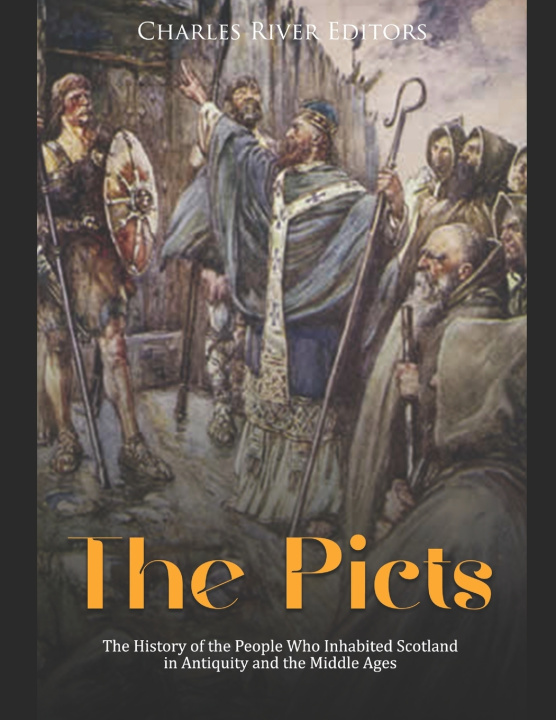
Among all of the late ancient and early medieval people in the British Isles, few were as influential as the Picts. First mentioned in Roman sources as one of the primary groups north of Hadrian's Wall, the Picts became known as barbarians who routinely raided the Romans and later the Britons, taking what they pleased and often returning to their mysterious land north of the wall. Unlike the Britons, who worked with and accepted many elements of Roman culture and society, the Picts were content to remain apart and be "barbarians," at least while the Romans remained in Britain.
After the Romans left Britain, the Picts played a larger role in the creation of medieval England. The Picts developed a culture as sophisticated as any medieval European culture, complete with writing, high art, and an aristocracy. The Picts also battled the Angles and the Saxons for control of what would become northern England, and they fought with their Irish-Scottish neighbors for supremacy over the mountains, islands, and lochs of Scotland, eventually merging with them to comprise the Scottish people. Thus, even as the Picts forged a unique culture that stood apart from its neighbors, sometimes in quite a hostile fashion, they were quite suited to integrate with the other people of Britain and eventually become Scottish and English. It would not be a mischaracterization to say the Picts were bellicose, martial, and geared toward war as a society, but it would be wrong and unfair to assume that this was all they knew. Furthermore, the Picts were influential in an era when there was a fine line between history and legend, which is a part of the reason why they are still viewed as enigmatic today.