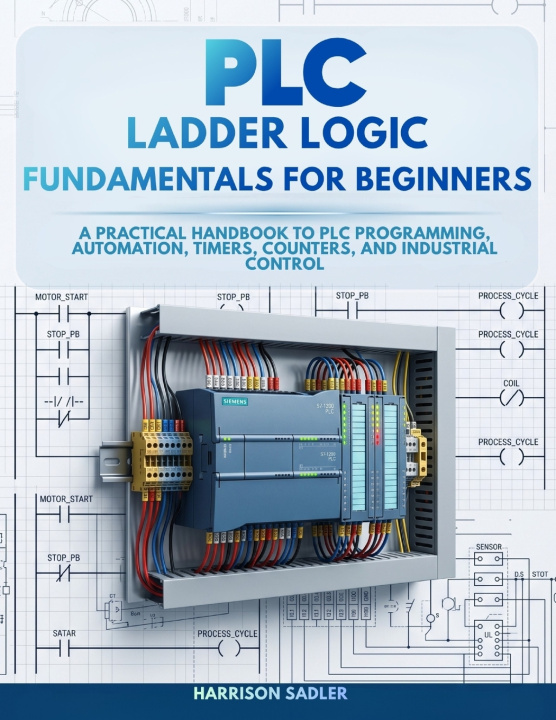
The control panel that runs a modern machine can look impossible to a newcomer: rows of terminals, humming relays, and a program full of unfamiliar symbols with no obvious place to begin. What most people entering industrial automation lack is not ability but a clear, patient starting point.
Demand for people who can understand and program these controllers keeps growing, yet the resources available often assume prior programming experience or tie every lesson to a single controller brand. The result is confusion, half-learned habits, and a quiet fear of the live panel. This handbook replaces that with understanding, teaching ladder logic one idea at a time, in plain language, from the relay circuits that inspired it to complete, working programs you can read, write, and test.
Because it is grounded in the international standard for ladder diagram programming rather than one manufacturer's software, what you learn transfers across the controllers you are most likely to meet in the field. Every chapter pairs clear explanation with fully worked examples, self-check questions and answers, and hands-on exercises, and every illustration is made to be studied, not skimmed.
Inside, you will:
- Understand how a controller reads inputs, runs its program, and updates outputs during every scan.
- Read a ladder rung with confidence, recognizing contacts, coils, and the series and parallel logic that connects them.
- Build the structures real machines rely on: seal-in circuits, latches, interlocks, timers, and counters.
- Use comparison and math instructions, data moves, and shift registers to work with values and data.
- Convert analog measurements into engineering units through scaling, and read the signals that sensors send.
- Trace faults with a systematic method and apply safe maintenance and lockout practices around energized equipment.
The book covers controller hardware and field wiring, the input-process-output model, the scan cycle, number systems and addressing, Boolean logic, latching and interlocking, the full family of timers and counters, data handling, program structure and documentation, analog input and output, sequential control, operator interfaces, and troubleshooting. It closes with a complete design project that draws every topic together into one working solution.
It is written for the complete beginner: the student, the apprentice electrician, the maintenance technician, and the career-changer who wants to understand how industrial machines are controlled. It assumes no programming background and only a basic familiarity with electricity, building every concept from the ground up.
Open this handbook and begin developing the confidence to open a real program, understand exactly what it does, and start writing dependable control logic of your own.