Most FPGA books bury you in Boolean algebra before touching a hardware description language, or dump raw syntax on you without explaining what the silicon actually does. This book does neither.
The central problem with learning FPGA development is not the tools, the language, or even the complexity of the hardware. It is the mental model. Software developers think sequentially. FPGAs are spatial machines. Until that distinction clicks, nothing else makes sense; not the timing failures, not the synthesis surprises, not the simulator that passes while the bench fails.
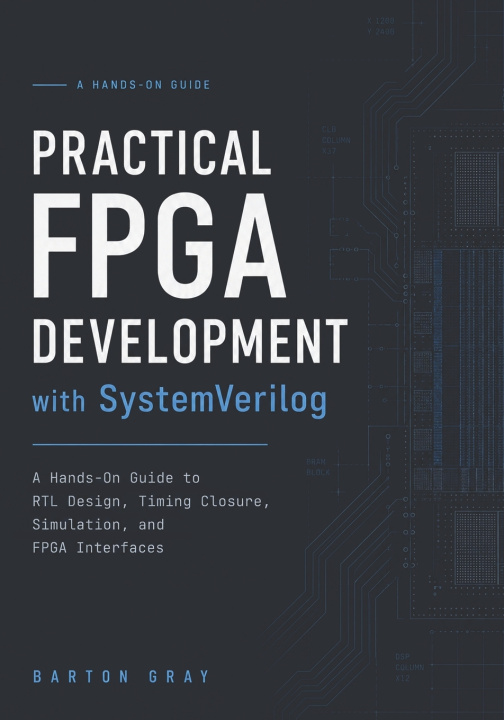
Practical FPGA Development with SystemVerilog builds that mental model from the ground up, then puts it to work.
Starting from how an FPGA actually functions beneath the vendor marketing vocabulary, the book moves through RTL design, timing closure, memory interfaces, and high-speed communication protocols. Every chapter is built around the engineering problems you will actually face. Every concept is grounded in the physical reality of the silicon, not academic abstraction.
You will learn:
- Why your simulator passes while your bench fails
- How to read a timing report before your design falls apart
- Why the for loop you just wrote consumed eight times the silicon you expected
- How metastability actually works and how to design around it
- What separates a hobbyist project from production hardware
Along the way you will build real things:
- A UART transmitter and receiver
- A FIFO-based data buffer
- An AXI-compatible peripheral module
- A PWM controller with hardware debouncing
- A complete integrated subsystem with professional verification and timing constraints
The book also covers FSM design, pipeline architecture, clock domain crossing, SPI and I2C interfaces, hardware debugging with integrated logic analyzers, and structuring larger FPGA projects for long-term maintainability.
This book is written for software developers transitioning into hardware, electrical engineering students who need practical RTL skills, and engineers who want to understand what their tools are actually doing to the silicon.
This is not a book about blinking LEDs. It is a book about understanding programmable silicon well enough to build systems that work the first time they hit real hardware - and debug them confidently when they do not.