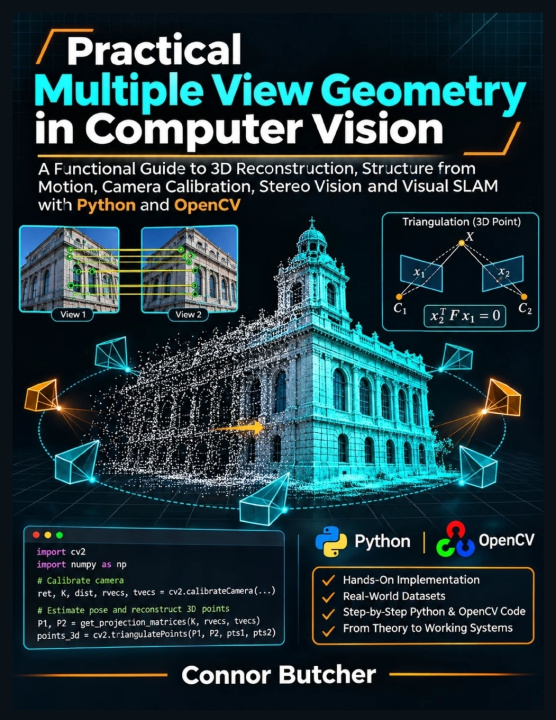
How can computer vision engineers turn geometric mathematics into reliable 3D results from real images? This manual connects multiple-view geometry with practical implementation...
Connor Butcher presents a structured progression through mathematical foundations, camera models, calibration, two-view geometry, stereo reconstruction, Structure from Motion, bundle adjustment and Visual SLAM. Explanations, numerical examples and geometric illustrations connect with Python, NumPy and OpenCV workflows, engineering projects and troubleshooting.
Readers learn to:
- Apply projective geometry and homogeneous coordinates.
- Interpret intrinsic and extrinsic parameters.
- Calibrate cameras and correct lens distortion.
- Estimate fundamental and essential matrices.
- Match features and reject outliers with RANSAC.
- Estimate homographies.
- Rectify stereo images and estimate disparity.
- Triangulate 3D points and recover camera pose.
- Develop sparse Structure from Motion.
- Understand bundle adjustment.
- Follow visual odometry, mapping and loop closure.
- Generate and inspect point clouds.
- Measure reprojection error and reconstruction quality.
- Recognise degeneracy and numerical instability.
- Diagnose reconstruction pipeline failures.
Advanced geometry can feel mathematical, and code examples may leave steps unexplained. Progressive explanations, worked calculations and implementation workflows address both. The book avoids promises of instant mastery, instead helping technically capable readers test assumptions, inspect results and verify outputs. Recommended foundations include linear algebra, basic 3D geometry, image processing and introductory programming.
Scroll up and click the "Add to Cart" button now to strengthen your understanding of camera calibration, epipolar geometry, stereo vision and practical 3D reconstruction with Python and OpenCV.