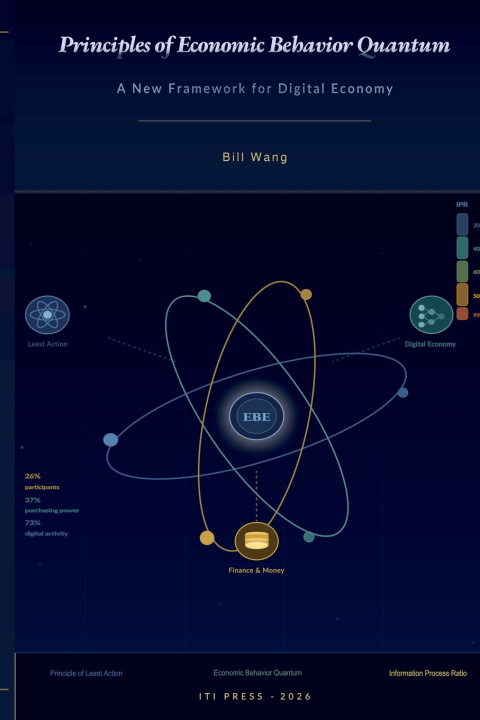
What if economic behavior obeys the same principle of least action that governs motion in physics?
Principles of Economic Behavior Quantum introduces Economic Behavior Theory (EBT)-an original framework that reimagines economic activity not as the aggregate choices of rational agents, but as a measurable, physics-like system governed by testable laws. At its foundation is the Economic Behavior Quantity (EBQ), a discrete, quantifiable unit of economic action built from the Economic Behavior Element (EBE) and linked into Economic Behavior Chains (EBC) that trace how value and decisions propagate through real economic systems.
The book situates this framework within a Triple-Space model (physical, information, and cognitive space), offering a unified way to describe how behavior moves between the physical marketplace, the digital/informational layer, and cognitive decisions.
Key Breakthroughs & Frameworks Inside:
- The 26/37/73 Statistical Regularity: An empirical pattern elevated to a testable law of behavioral distribution.
- The Seven-Element Representation Framework: A complete system for characterizing any economic behavior.
- Financial System Tension Index (FTI): A new measure of systemic financial stress, market friction, and stability.
- Information-Theoretic Value: Extending Shannon-style information concepts into economic exchange and currency mechanics.
- Variational & Least-Action Methods: Direct applications to financial markets, algorithmic trading, and cryptocurrency systems.
Rather than staying purely theoretical, the book grounds every major claim in extensive empirical work-most notably a detailed case study validating the framework against China's digital economy, alongside spatial economic analysis of cities as physical gathering points of economic behavior.
Who Is This Book For?
Written by a physicist-turned-economist with a background advising international science and technology policy bodies, this treatise offers economists, quantitative researchers, policy analysts, and digital-economy practitioners a rigorous, physics-inspired lens for understanding economic behavior in an increasingly algorithmic age.