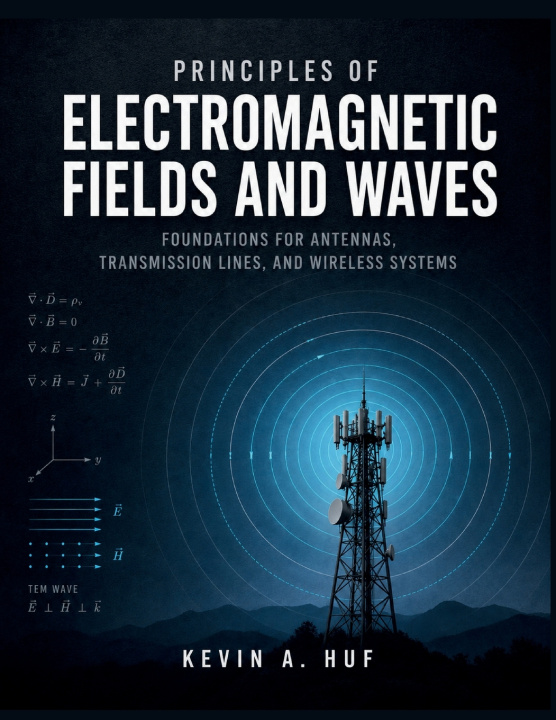
Many engineering students can recite Maxwell's equations, yet still cannot explain why a transmission line reflects a pulse back toward its source, why a hollow metal tube has a cutoff frequency below which no signal will pass, or how a current distribution on a piece of wire produces the far-field pattern of an antenna. This gap between formula and reasoning is common, and it is what this book is built to close.
Organized as one continuous development, the book begins with the vector calculus and coordinate-system tools that every later chapter depends on, then builds electrostatics, magnetostatics, and material behavior from stated assumptions through complete derivations and fully worked examples. It derives Maxwell's equations for time-varying fields and shows, step by step, how those equations lead to the electromagnetic wave equation, then carries that foundation through wave propagation, polarization, and behavior in lossy and dispersive media, reflection and transmission at boundaries, transmission-line theory and impedance matching, waveguide and cavity-resonator theory, antenna radiation and arrays, electromagnetic compatibility, and the numerical methods used in modern electromagnetic simulation.
Readers will work through:
- A complete vector-calculus and coordinate-system foundation before it is put to use.
- Electrostatics and magnetostatics derived from stated assumptions through to worked, fully solved examples with verified answers.
- The passage from Maxwell's equations to plane-wave propagation, polarization, and behavior in lossy and dispersive media.
- Reflection and transmission at normal and oblique incidence, and impedance matching with quarter-wave transformers.
- Transmission-line modeling with the telegrapher's equations, Smith-chart and stub matching techniques, and transient pulse behavior relevant to digital signal integrity.
- Waveguide mode structure, cutoff frequency, and cavity resonance connected directly to microwave-component design.
- Antenna radiation pattern, directivity, gain, array factor, and electromagnetic-compatibility fundamentals including shielding, grounding, and filtering.
- An introduction to the finite-difference time-domain, method-of-moments, and finite-element approaches used in electromagnetic simulation software.
Every chapter pairs its derivations with worked examples carrying verified, boxed answers, addresses common misconceptions, and closes with an applied-context section connecting the theory to real engineering systems, so the reasoning is never left disconnected from practice.
This book is written for upper-level undergraduate engineering students, graduate students beginning coursework in fields and waves, and practicing engineers who need a rigorous, derivation-complete reference covering foundational theory through applied antenna, transmission-line, and computational topics.
Begin building a clearer, derivation-level understanding of electromagnetic theory with a single reference designed to carry you from first principles through to applied engineering practice.