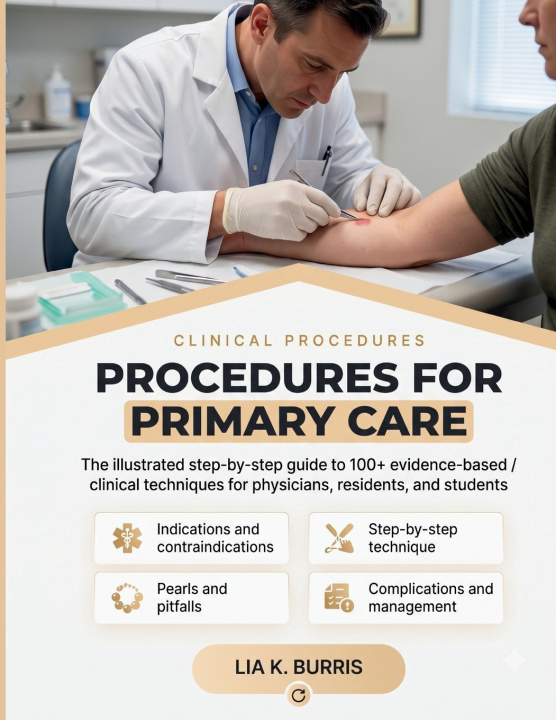
The scope of procedures performed in primary care has widened dramatically. Techniques once confined to subspecialty offices and hospital suites are now routine in family medicine practices, urgent care centers, and community clinics. Point-of-care ultrasound guides bedside aspirations, office aesthetic procedures have entered general practice, and skills like colposcopy, vasectomy, and joint injection are expected of the complete primary care clinician. Procedures for Primary Care is the single reference built for this expanded scope.
The book covers more than one hundred procedures across fourteen clinical sections. Each procedure is presented the way a senior clinician would teach it: direct, evidence-based, and free of padding. Every chapter follows an identical structure, so the information you need is always in the same place:
- Indications and contraindications, listed before technique without exception
- Equipment lists written to function as preparation checklists
- Step-by-step technique in numbered, single-action steps
- Complications with incidence, recognition, and management
- Post-procedure care, follow-up intervals, and patient instructions
- Key points and the current evidence supporting each procedure
Four features distinguish this reference:
- Honest evidence grading in every chapter, stating plainly whether a recommendation rests on randomized trials, observational data, or expert consensus
- Integrated guidelines from AAFP, ACOG, AHA, AAP, ASRA, and other authoritative bodies where they affect technique and patient selection
- Patient safety woven throughout, with contraindications first and safety alerts placed at the precise point of risk, rather than treated as an afterthought
- Attention to the realities of practice, including CPT coding references, consent considerations, and documentation
The fourteen sections cover the full range of contemporary practice:
- Foundations of procedural practice, including anesthesia, aseptic technique, and consent
- Dermatology and wound procedures, from biopsy and laceration repair to nail and abscess management
- Aesthetic and cosmetic procedures, including botulinum toxin, fillers, peels, and sclerotherapy
- Eyes, ears, nose, and throat procedures
- Cardiovascular and respiratory procedures
- Gastrointestinal procedures, including endoscopy and anorectal techniques
- Urinary and male reproductive procedures
- Gynecology and female reproductive procedures, including colposcopy, LEEP, IUD, and implant insertion
- Obstetric procedures, from ultrasound to delivery and neonatal resuscitation
- Pediatric procedures
- Musculoskeletal and sports medicine procedures, including joint injection, casting, and reduction
- Urgent and emergency procedures
- Hospitalist and advanced procedures, including airway management, central access, and lumbar puncture
A dedicated section on point-of-care ultrasound addresses its role in vascular access, joint aspiration, and pleural procedures. Extensive appendices provide instrument references, consent templates, CPT and ICD-10-CM codes, reference values, scoring systems, and patient education handouts.
Written by Lia K. Burris for practicing physicians, residents, and medical students, this illustrated reference is designed for two modes of use: rapid consultation during procedural preparation and systematic study during training. It prepares the clinician to perform each procedure with technical confidence, a clear grasp of the risks, and a working knowledge of the evidence behind it.