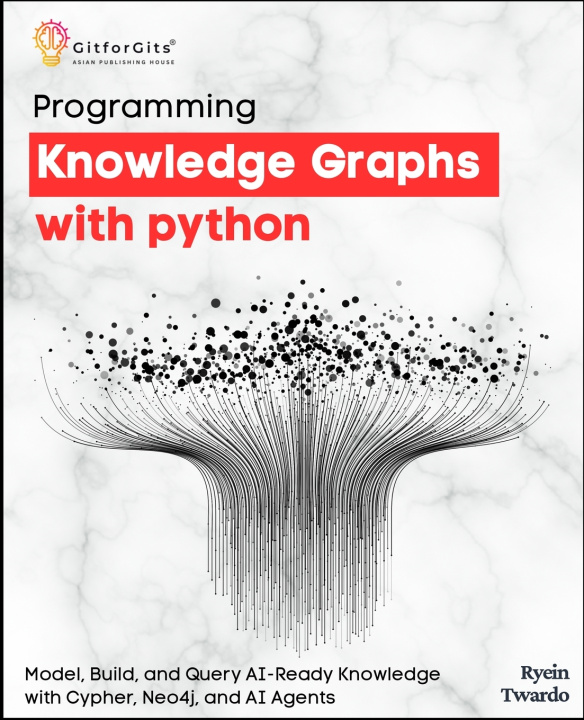
Get practical hands-on to build your own knowledge graph, and use it across retrieval, analytics and agents
LLMs sound confident, but they forget context, invent facts and can't show their reasoning. A knowledge graph gives them structured, traceable facts to work from. What you'll do in this book is grow a single Neo4j graph from the Python Enhancement Proposals, which are the documents that shaped the language. It starts with getting to grips with nodes and relationships and writing Cypher like a pro. Then you design a schema in Pydantic, chunk documents into a lexical graph and extract entities with spaCy and local LLMs. Then, you add vector embeddings and indexes, and combine full-text search, vector search and graph traversal into GraphRAG retrieval that cites its sources.
The rest of the book goes into more detail. You can rank and cluster nodes with Graph Data Science, infer new facts with rules, import ontologies and validate data with SHACL. You also give LangGraph agents guarded Cypher tools, serve the graph over MCP, store agent memory with Graphiti and trace every decision. At the end of the day, you keep the graph healthy with regular refreshes, time-bound facts, evaluation runs, query tuning and backups.
Key Learnings
Write expressive, parameterized Cypher queries from Python.
Design graph schemas with Pydantic, constraints and indexes.
Chunk documents into lexical graphs with batched ingestion pipelines.
Extract entities and relationships using spaCy rules and schema-guided local LLMs.
Store embeddings in Neo4j and query them through vector indexes and similarity metrics.
Build GraphRAG retrievers for full-text, vector search and subgraph expansion.
Rank, cluster and predict links with PageRank, Leiden and GDS pipelines.
Infer facts with Cypher rules, SKOS ontologies and SHACL shape validation.
Connect LangGraph agents to graphs through guarded Cypher tools, MCP and Graphiti memory.
Operate graphs with incremental refreshes, temporal facts, evaluation runs, tuning and backups.
Table of Content
Thinking in Nodes and Relationships
Writing Cypher with Confidence
Designing Graph Schema
Preparing Data and Chunks
Extracting Entities and Relationships
Structuring Embeddings in Graphs
Retrieving with Vectors and Structure
Analyzing Graph Structure
Reasoning Symbolically over Knowledge
Connecting AI Agents to Graphs
Keeping Knowledge Graphs Healthy