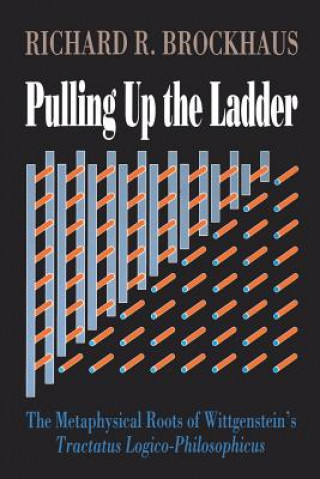
Könyv Pulling Up the Ladder Richard D. Brockhaus

Pulling Up the Ladder

Metaphysical Roots of Wittgenstein's "Tractatus"

Nyelv: Angol
Kötés: Puha kötésű
Elérhetőség: Beszállítói készleten
Küldés 9-15 napon belül
11 855 Ft
"Pulling up the Ladder" discusses how Wittgenstein's early philosophy became widely known largely th...


Információk a könyvről

Nyelv
Angol
Kötés
Könyv - Puha kötésű
Kiadva
1991
oldal
356
EAN
9780812691269
ISBN
0812691261
Enbook ID
04724546
Súly
523
Méretek
152 x 229 x 20

Teljes leírás

"Pulling up the Ladder" discusses how Wittgenstein's early philosophy became widely known largely through the efforts of Russell and other empirically-minded British philosophers, and to a lesser extent, the scientifically-oriented German-speaking philosophers of the Vienna Circle. However, Wittgenstein's primary philosophical concerns arose in a far different context, and failure to grasp this has led to many misunderstandings of the "Tractatus". From Brockhaus' investigation of that context and its problems emerges this new interpretation of Wittgenstein's early thought, which also affords fresh insights into the later Wittgenstein. Wittgenstein's first philosophy was a Schopenhauerian neo-Kantianism, and although he soon rejected much of the substance of Schopenhauer's work, his problems remained closely connected with Schopenhauer's view of the world and man's relation to it. Wittgenstein's early philosophy is a departure from Schopenhauer - a rigorously purified form, so to speak, of Schopenhauer's "World as Will and Representation". In "Pulling up the Ladder", Brockhaus explains Schopenhauer's system of the world as Will and Representation, then proceeds to investigate Frege's realism and Hertz's conventionalistic philosophy of science - two of the elements which fuelled Wittgenstein's purification of Schopenhauer. Brockhaus analyzes the relations between the "Tractatus" and Russell's treatment of Incomplete Symbols and Logical Types. He investigates two Schopenhauerian issues which present difficulties for the Wittgensteinian world-view: the principles of mechanics and the propositional attitudes which bring the ego into the world. The final chapters examine the metaphysical ego and its relaxation to value, employing Wittgenstein's metaphor of "my world", since "my world" is permeated by the metaphysical ego, the Schopenhauerian World as Will emerges anew, albeit in a curiously ineffable form.

Érdekelheti

Question It!

Paula Smith
9 475 Ft

Freeman's Power

John Freeman
5 053 Ft
16 907 Ft
3 766 Ft

The Night Circus

Erin Morgenstern
3 595 Ft

SQL for Data Analytics

Matt Goldwasser
30 076 Ft
11 572 Ft
3 208 Ft
7 675 Ft
8 976 Ft
10 060 Ft

Redemption's Whisper

Kathleen Friesen
5 264 Ft

Humans Being

Ph. D. Lou Ann Daly
17 092 Ft
38 633 Ft

Happy Cake Days

Wendy Schlagwein
9 646 Ft

Routes and Realms

Zayde Antrim
36 924 Ft

What Kind of Fairy is Merry Berry

Lindsey Renee Skaife-Flynn
4 180 Ft
3 982 Ft

Azok a vásárlók, akik ezt a könyvet megvásárolták, a következőket is megvásárolták

16 777 Ft

Podsłuchane praskim uchem

Tomczak Stanislaus
2 983 Ft

Tour de France

Stephan Klemm
11 513 Ft
7 918 Ft

Provenienz

Sarah Gaber
14 181 Ft
1 129 Ft
3 603 Ft
7 806 Ft
11 657 Ft

300

Frank Miller
9 758 Ft

2. Englischjahr

Ludwig Waas
3 424 Ft