Certainly - let me redraft this properly to match the new title, rather than merely patching the old version.
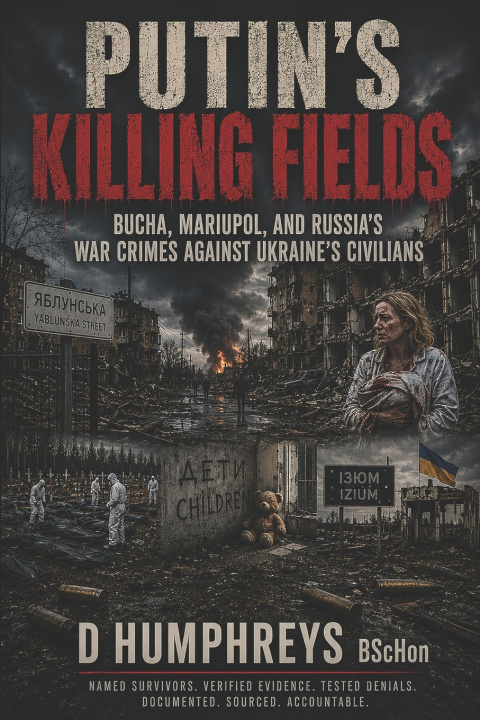
PUTIN'S KILLING FIELDS: Bucha, Mariupol, and Russia's War Crimes Against Ukraine's Civilians
On 4 March 2022, nine men were marched at gunpoint into an ordinary office building on a residential street in Bucha, Ukraine. Eight were executed. The ninth, a taxi driver named Ivan Skyba, survived only because he pretended to be dead among the bodies of his neighbours for three days. His testimony - and that of dozens of other named survivors, forensic investigators, and international officials - forms the evidentiary spine of this book.
Vladimir Putin has done this before. Twenty-three years earlier, as Russia's acting president, he personally oversaw the near-total destruction of Grozny, a campaign the United Nations designated the most destroyed city on Earth. Putin's Killing Fields traces the direct, documented line from that campaign through Aleppo to Bucha, Mariupol, and Izium - arguing, with the evidence assembled street by street, that what happened in Ukraine was not the work of undisciplined soldiers, but a method this one man has now rehearsed and deployed three times.
This is a single-subject narrative history, not a broader war history in which atrocity appears as a chapter. Readers will meet the survivors by name: Ivan Skyba and Serhiy Chmut on Yablunska Street; Mariana Vishegirskaya, photographed fleeing Mariupol's bombed maternity hospital in blood-streaked pyjamas; Andriy Kotsar and Mykola Mosyakyn, tortured in a numbered-room detention facility in occupied Izium; a mother in Kherson hunted by drone while tending her goats. Structured across seventeen chapters and four parts - the doctrine behind the violence, the atrocities themselves, the machinery of filtration and deportation used against the living, and the slow work of documentation and prosecution - the book also follows the institutions built to hold Putin personally accountable: the International Criminal Court's arrest warrant naming him directly, the newly established Special Tribunal for the Crime of Aggression, and the sophisticated denial apparatus deployed against every one of these findings, tested here claim by claim rather than dismissed by assertion.
This is a work of narrative nonfiction, not advocacy journalism dressed as history. Every name, quotation, and disputed figure has been checked against named, dated sourcing - the Washington Post's field investigation of Bucha, AP and FRONTLINE's forensic reconstruction of the Yablunska Street killings, Human Rights Watch, Amnesty International, the United Nations Human Rights Monitoring Mission, and the ICC's own formal filings. Where a claim remains contested or unverified, the book says so plainly. Where Russian officials have denied an atrocity, that denial is tested against the physical evidence rather than waved aside.
Written in the tradition of Luke Harding's Invasion and Iris Chang's The Rape of Nanking, Putin's Killing Fields is distinguished by its single-minded focus: this is not a book about the war in Ukraine in general, but about what one man's forces have done, specifically and repeatedly, to its civilians - and about the people, living and dead, who bore witness to it.
The war this book documents has not ended. Neither has the accounting.