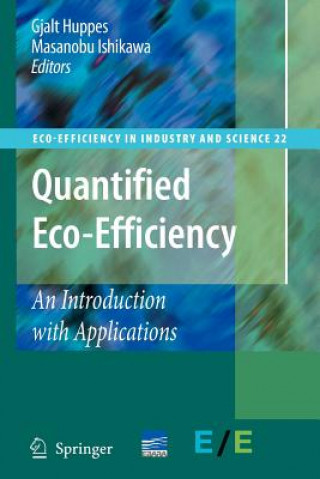
Eco-efficiency has long been a concept: the intention of reducing environmental impact while increasing environmental value. Its origins are with the World Business Council for Sustainable Development. However, in a globalized world with sustained economic growth environmental degradation is threatening. Macro level requirements on sustainability should be reflected in the eco-efficiency of choices at a micro level, like on technologies, supply chains and product systems. Eco-efficiency analysis has come to fruition as a fully quantified method for analysis, linking to specific domains of economic modelling, specific environmental models, and several methods for integrating these two domains into eco-efficiency scores. This eco-efficiency analysis can guide choices in policy, business, and consumptions activities, all from a single common background.§A central asset of eco-efficiency analysis is that it does not depend on a specific evaluation of environmental impacts against economic effects, avoiding the often disputed results of neo-classical evaluation methods. For integrating the different environmental scores several evaluation methods may be used including those based on willingness-to-pay, panel procedures, and public statements on policy goals. Each may have advantages, but in line with the normative neutrality strived for in eco-efficiency, these preference and value choices may be avoided to some extent. This can be done either by taking a common denominator or by having less demanding objectives, for instance focusing on efficiency of measures only. §A substantial Japanese paper on Maximum Abatement Cost method and a paper on revealed public preferences in The Netherlands comprise the first section on methods. Next, there are four sections on domains of application of eco-efficiency analysis. In the Agriculture section, a case on conservation agriculture in China is worked out, using input-output analysis. In the Industry section, cases range from supply chain management to waste water management and methods to speed up innovation. In the Products & Consumption section, cases refer to overall household performance, specific energy products and methods for upgradeable product design. Finally, in the Recycling section, cases relate to increasing the supply of secondary materials and to increasing secondary materials use.Eco-efficiency has long been a concept: the intention of reducing environmental impact while increasing environmental value. Its origins are with the World Business Council for Sustainable Development. However, in a globalized world with sustained economic growth environmental degradation is threatening. Macro level requirements on sustainability should be reflected in the eco-efficiency of choices at a micro level, like on technologies, supply chains and product systems. Eco-efficiency analysis has come to fruition as a fully quantified method for analysis, linking to specific domains of economic modelling, specific environmental models, and several methods for integrating these two domains into eco-efficiency scores. This eco-efficiency analysis can guide choices in policy, business, and consumptions activities, all from a single common background.§A central asset of eco-efficiency analysis is that it does not depend on a specific evaluation of environmental impacts against economic effects, avoiding the often disputed results of neo-classical evaluation methods. For integrating the different environmental scores several evaluation methods may be used including those based on willingness-to-pay, panel procedures, and public statements on policy goals. Each may have advantages, but in line with the normative neutrality strived for in eco-efficiency, these preference and value choices may be avoided to some extent. This can be done either by taking a common denominator or by having less demanding objectives, for instance focusing on efficiency of measures only. §A substantial Japanese paper on Maximum Abatement Cost method and a paper on revealed public preferences in the Netherlands comprise the first section on methods. Next, there are four sections on domains of application of eco-efficiency analysis. In the Agriculture section, a case on conservation agriculture in China is worked out, using input-output analysis. In the Industry section, cases range from supply chain management to waste water management and methods to speed up innovation. In the Products & Consumption section, cases refer to overall household performance, specific energy products and methods for upgradeable product design. Finally, in the Recycling section, cases relate to increasing the supply of secondary materials and to increasing secondary materials use.