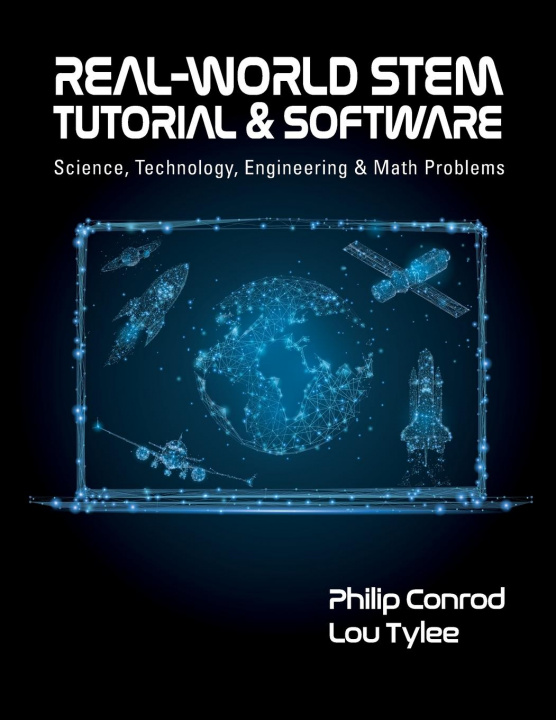
Teachers are always looking for real-world examples of Science, Technology, Engineering and Mathematics problems. The Real-World STEM textbook covers some key points in solving problems – stressing the solution of real, not textbook, problems. Topics range from simple logic problems to using calculus to model complicated systems.
Home Heating Mathematics reviews the math behind thermostats and furnace operations. We discuss the mathematics behind a thermostat and provide equations that allow computation of temperature changes within a home.
Satellite Orbit Problems reviews the dynamics behind satellite motion illustrating typical orbits, orbit transfers and rendezvous problems. In this chapter, we look at some of the mathematics and physics behind satellite orbits.
Pendulums and Complex Numbers reviews how complex numbers are used in a real problem – pendulum motion. In the study of quadratic equations, students are introduced to the concepts of imaginary and complex numbers.
A Look at Real-World Problem Solving reviews the trajectory of a projectile. This problem has a wide variety of real applications: rocket and missile launching, targeting and intercepts, satellite orbit transfers and rendezvous, numerical optimization, polynomial root finding, and solving nonlinear equations. In this chapter, a closed-form expression to the trajectory problem.
Another Look at Real-World Problem Solving reviews a numerical approach problem solving. In this chapter, we look again at the projectile problem, but the solution emphasis is on iterative, numerical solutions. Both one-dimensional and two-dimensional solution methods are discussed, as are some of the checks that must be made and the pitfalls that should be avoided when using such methods.
Solving Problems Numerically is a discussion of numerical methods for solving “unsolvable” problems. In this chapter, we look at solving two problems numerically. The first problem (one-dimensional) requires the determination of a model rocket engine’s burn time in order to achieve a desired altitude. The second problem (two-dimensional) is a numerical implementation of converting from rectangular to polar coordinates.
Mathematics of Robot Arms reviews the mathematics behind the modes of robot arm operation. In this chapter, we will look at the mathematics behind robot arms. We will study trajectory planning. We look at three basic problems: kinematics, inverse kinematics and trajectory planning. We examine each of these problems separately, using the two-link robot arm.
Fractals from Polynomial Solutions is an illustration of the beauty of math – how solving for the roots of a polynomial can generate beautiful fractal graphics. In this chapter, we study the Newton-Raphson method for finding roots. We develop a procedure for generating fractals from the solution of a general polynomial.
Chaos in a Real System reviews how something as simple as a water wheel can exhibit chaotic, strange behavior. In this chapter, we model a four-bucket version of the Lorenz water wheel – a famous system that exhibits a chaotic nature. This chapter has detailed dynamics equations to build a simulation.
Computing Airplane Takeoff Speeds reviews how a pilot knows how fast an airplane needs to be going prior to takeoff. This chapter describes the process performed by an onboard airplane computer in determining speeds the pilot uses in making decisions during takeoff.
Computing Airplane Stopping Distance reviews how derivatives can be applied to real-world problems. This chapter presents two applications of derivatives related to computing the distance required to stop an airplane. First, we look at using curve-fitting techniques to develop an equation for brake force. Second, we develop equations for the deceleration and speed of an airplane (simple differential equations).