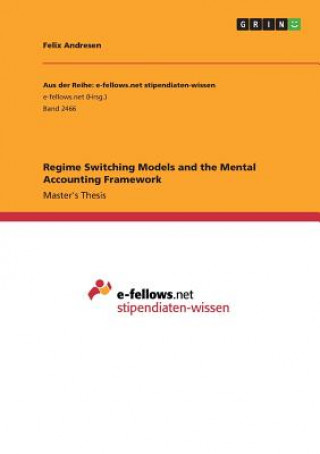
Könyv Regime Switching Models and the Mental Accounting Framework Felix Andresen

Regime Switching Models and the Mental Accounting Framework

Szerző: Felix Andresen
Nyelv: Angol
Kötés: Puha kötésű
Kiadó: Grin Publishing
Elérhetőség: Beszállítói készleten
Küldés 5-8 napon belül
16 458 Ft
Master's Thesis from the year 2014 in the subject Economics - Finance, grade: 1,0, Frankfurt School...


Információk a könyvről

Szerző
Nyelv
Angol
Kötés
Könyv - Puha kötésű
Kiadva
2017
oldal
108
EAN
9783668486546
ISBN
3668486549
Enbook ID
16804195
Súly
167
Méretek
148 x 210 x 7

Teljes leírás

Master's Thesis from the year 2014 in the subject Economics - Finance, grade: 1,0, Frankfurt School of Finance & Management, language: English, abstract: The main goal of this thesis is to combine all of these concepts into a unified framework, evaluate its feasibility and performance, and to perform an analysis of the most common pitfalls and practical considerations. This unified framework uses both the MVPT and MA approach for asset allocation, but at the same time allows for dynamic and fat-tailed distributions of asset returns. It is implemented in approximately 1200 lines of efficient MATLAB code, which is publicly available at The application is programmed in a way that it is readily expandable to a larger number of assets and other investment approaches. The framework is also independent on the choice of assets, which is why the choice of assets for the illustration of the thesis findings was based on the availability of data. The thesis is structured as follows. Chapter 2 reviews the current literature and theoretical concepts. More specifically, Chapter 2.1 introduces the Mental Accounting framework and the connections and differences to Markowitz's Mean Variance Portfolio Theory. In Chapter 2.2 the most important concepts of dynamic investment management and stochastic programming are introduced. Chapter 2.3 discusses the regime switching models used to generate scenarios for the stochastic programming approach and the important topic of model selection. Chapter 2.4 gives an overview of Gaussian Mixture Models which present a tool to create the expected distribution used to optimize the asset allocation. In Chapter 3 all the pieces from the theoretical parts are brought together to formulate the dynamic programming models and the hypotheses to be tested in the thesis. The market data used to carry out the analysis is discussed in Chapter 4, as well as some necessary methodology on how to calculate, aggregate and interpret asset returns. Chapter 5 presents exemplary and illustrative results, and discusses the strengths and weaknesses of the MVPT and MA investment approaches. The thesis closes with a summary and conclusion in Chapter 6.

Érdekelheti

11 039 Ft

If You Came This Way

Peter (University of Auckland) Davis
4 141 Ft

You Got This!

SCOTT CARTER
4 663 Ft
5 680 Ft

Upstaged

Aaron Paul Lazar
4 951 Ft

Rap Psalm

Sam P Edwards
3 921 Ft

Croakers

Cindy L Grier
6 449 Ft
3 266 Ft
108 390 Ft

Abraham

James G. Whitelaw
4 109 Ft

Kingdom Come

Brett Murphy
6 770 Ft

Normally Unusual

Vince Kitchen
6 101 Ft

Pug Planner 2024

Happy Oak Tree Press
4 677 Ft

Azok a vásárlók, akik ezt a könyvet megvásárolták, a következőket is megvásárolták