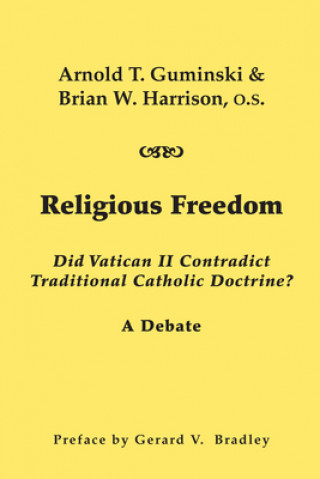
Könyv Religious Freedom - Did Vatican II Contradict Traditional Catholic Doctrine? A Debate Gerald V. Bradley

Religious Freedom - Did Vatican II Contradict Traditional Catholic Doctrine? A Debate

Nyelv: Angol
Kötés: Puha kötésű
Elérhetőség: Beszállítói készleten alacsony példányszámban
Küldés 13-18 napon belül
13 793 Ft
One of the gravest and most divisive issues confronting the Catholic Church in recent decades – a ma...

Információk a könyvről

Nyelv
Angol
Kötés
Könyv - Puha kötésű
Kiadva
2013
oldal
288
EAN
9781587316982
ISBN
1587316986
Enbook ID
12328403
Súly
544
Méretek
152 x 226 x 25

Teljes leírás

One of the gravest and most divisive issues confronting the Catholic Church in recent decades – a major factor in an ongoing institutionalized rupture between Rome and at least half a million traditionalist Catholics – is the question of whether Vatican II’s Declaration Dignitatis Humanae can be reconciled with traditional Church doctrine on religious liberty. In this spirited exchange of essays on a topic central to our understanding of justice and human rights, Arnold Guminski and Fr. Brian Harrison debate this difficult question. Guminski argues that DH teaches that there is (and always has been) a natural right not to be prevented from publicly propagating or manifesting non-Catholic religions, subject to the exigencies of a just public order, which is to be understood as not presupposing the truth of natural or any positive religion (including Catholicism), or any supernatural considerations. Harrison disagrees. In his view, DH nowhere teaches that it is always and everywhere unjust for civil authorities to presuppose the truth of Roman Catholicism in determining what restrictions a just public order allows. According to Harrison, the central innovative feature of DH is its clearly implied prudential policy judgment, or norm of ecclesiastical public law, to the effect that in the modern world – so very different from the old Christendom – repression of the public propagation or manifestation of non-Catholic religions as such can no longer be justified by the requirements of the common good. Harrison argues that precisely because this undeniable reversal of the Church’s previous position belongs in the category of changeable prudential judgments, it does not constitute a doctrinal rupture with Catholic tradition. Guminski, on the other hand, contends that the doctrine of DH, properly understood, is inconsistent with relevant preconciliar doctrine. The latter, in his view, was never proposed definitively – i.e., infallibly. Both authors agee to a comprehensive theory of the nature and scope of the Church’s inherent coercive power as it pertains to liberty in religious matters. They agree that this power is limited to the imposition of spiritual penalties and temporal penalties, and that the Church’s inherent coercive power nevertheless must be exercised within the limits of a just public order.

Érdekelheti

Azok a vásárlók, akik ezt a könyvet megvásárolták, a következőket is megvásárolták

11 445 Ft
7 936 Ft
5 227 Ft
7 689 Ft
15 584 Ft

Estancias

Gibran Jalil Gibran
5 139 Ft

Hegel

Benoit Timmermans
9 177 Ft
10 357 Ft