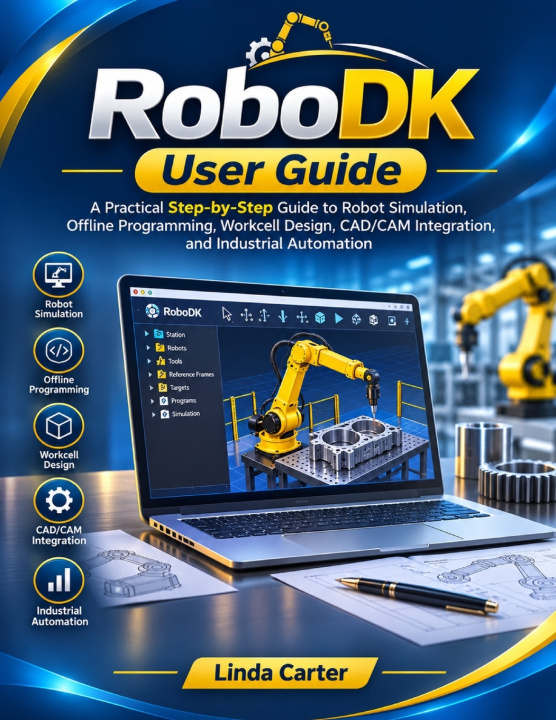
RoboDK User Guide
A Practical Step-by-Step Guide to Robot Simulation, Offline Programming, Workcell Design, CAD/CAM Integration, and Industrial Automation
Master Robot Simulation, Build Virtual Workcells, and Explore Industrial Automation with Confidence!
Are you ready to explore the powerful world of industrial robotics and offline robot programming? Do you want to learn how to simulate robotic operations, design efficient workcells, generate robot programs, and integrate CAD/CAM workflows without relying entirely on physical robot equipment?
RoboDK User Guide by Britney Light provides a practical, beginner-friendly introduction to RoboDK, helping you understand the essential tools, techniques, and workflows used in modern robotic automation.
Whether you are an engineering student, robotics enthusiast, manufacturing professional, technician, or automation beginner, this guide takes you from fundamental concepts to more advanced applications through clear explanations, structured instructions, and practical examples.
What You'll Learn Inside
Getting Started with RoboDK: Understand industrial robotics, install RoboDK, navigate the interface, and manage your first projects.
Building Virtual Robot Workcells: Select industrial robots, import CAD models, position equipment, and organize realistic manufacturing environments.
Mastering Robot Tools and Coordinate Systems: Configure reference frames, define Tool Center Points (TCPs), and create accurate robot targets.
Programming Robot Movements: Understand joint, linear, and circular movements while developing structured robot programs.
Simulation and Collision Detection: Evaluate robot reachability, identify potential collisions, improve movement paths, and estimate cycle times.
Offline Programming and Post Processors: Learn how to generate robot programs for compatible industrial robot controllers.
CAD/CAM Integration: Explore robotic machining, welding, painting, cutting, dispensing, material handling, and additive manufacturing workflows.
Python API and Automation: Discover how scripting can automate repetitive operations and simplify robot programming tasks.
Advanced Robotics and Deployment: Explore external axes, physical robot connections, troubleshooting, and practical deployment considerations.
More Than Just Theory
This guide also includes practical project walkthroughs, essential robotics terminology, interface references, troubleshooting advice, and project planning checklists to help reinforce your learning.
Who Is This Book For?
This book is ideal for:
Beginners learning RoboDK and industrial robotics.
Engineering and technical students exploring robot simulation.
Manufacturing professionals interested in robotic automation.
Robot programmers learning offline programming techniques.
CAD/CAM users expanding into robotic manufacturing.
Educators, technicians, and automation enthusiasts seeking a structured learning resource.
Start Building Your Robotics Skills Today!
Industrial automation continues to transform manufacturing, and understanding robot simulation and offline programming is a valuable step toward developing practical robotics skills.
With RoboDK User Guide, you'll gain the foundational knowledge and practical guidance needed to create virtual robot workcells, develop robot programs, explore automation workflows, and approach more complex robotics projects with greater confidence.