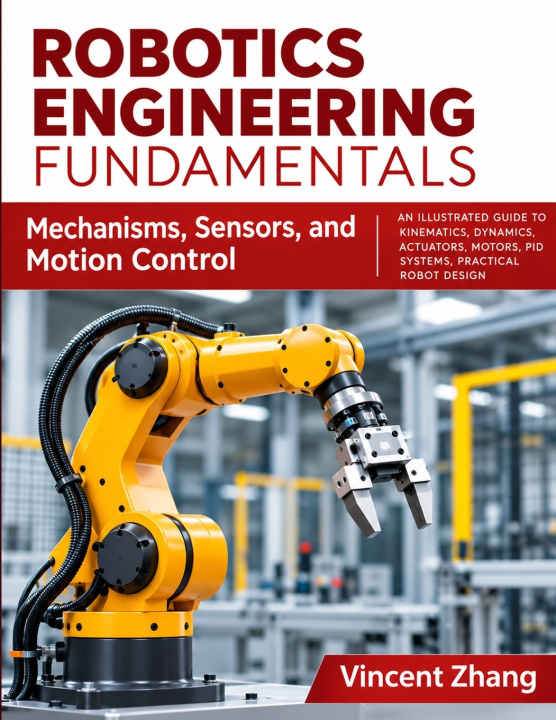
When you encounter understanding how a robot moves, senses, and responds, where do you begin?
A robot combines mechanics, electronics, sensing, and mathematical reasoning; learning each topic alone does not necessarily explain how the whole machine behaves. This book is conceived as a guided introduction that helps readers build a connected conceptual understanding of robotic components, motion calculations, sensing, and feedback. Rather than treating every component as an unrelated definition, the emphasis is on what each part contributes to the operation of a complete system.
Key areas of study include:
- Relating joints, links, transmissions, and structures to robot movement
- Using coordinate frames to describe position and orientation
- Understanding forward and inverse motion calculations
- Connecting forces, torques, and inertia to actuator selection
- Comparing encoder and inertial measurement principles
- Exploring feedback, trajectory choices, and system integration
The learning path moves from fundamental ideas to applied interpretation. By comparing components, relationships, and the consequences of design choices, readers can form a more useful technical vocabulary and ask better questions when studying unfamiliar equipment.
Designed for engineering students, technical learners, robotics enthusiasts, and early-career practitioners, the book assumes curiosity and willingness to build familiarity with engineering terminology. It does not claim to qualify a reader to work on energized machinery or commission safety-critical equipment.
Start with the underlying principles, then move through the connections that make technical drawings and engineered systems meaningful.