Why do we use the same word for a speed limit and the law of gravity?
A law passed by a parliament can be broken, changed, or repealed. A law of nature cannot. When a person breaks the law, we blame the person. When nature seems to break a law, we blame the law. Between them stands a third kind of rule, the law of thought, which tells us when a conclusion really follows from what came before.
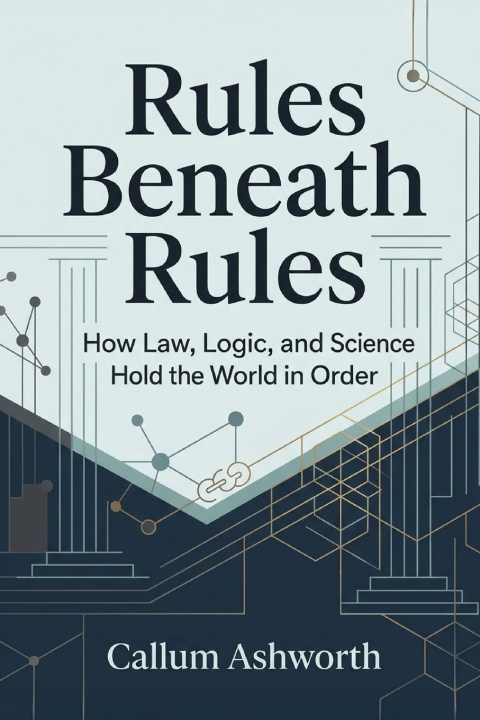
Rules Beneath Rules is a clear, plain-language journey through these three kinds of order: the law of the land, the law of nature, and the law of logic. It shows how each one works, how they differ, and how deeply they depend on one another.
Inside, you will discover:
- What makes a rule a real law, and not just an order backed by force
- Why some patterns in nature count as laws while others are only accidents
- How judges actually reason, and why the courtroom is not a logic machine
- Why no amount of facts can, by itself, tell us what we ought to do
- How a single error in probability helped send an innocent mother to prison
- What Galileo, the Scopes trial, and modern courts reveal about science on trial
- Where logic itself runs out, from ancient paradoxes to Gödel and Turing
- Whether machines can ever follow rules the way people do
- A practical field guide to the most common ways arguments go wrong
Drawing on thinkers from Aristotle and Cicero to Hume, Hart, Popper, Kuhn, and Wittgenstein, this book explains difficult ideas through everyday examples: a traffic light, a falling stone, a family argument at the dinner table, a child learning to ride a bicycle.
No equations. No jargon. No background in law, science, or philosophy required. Just patience and a willingness to ask why.
For curious readers, students, jurors, voters, and anyone who wants to think more clearly in a world full of rules.