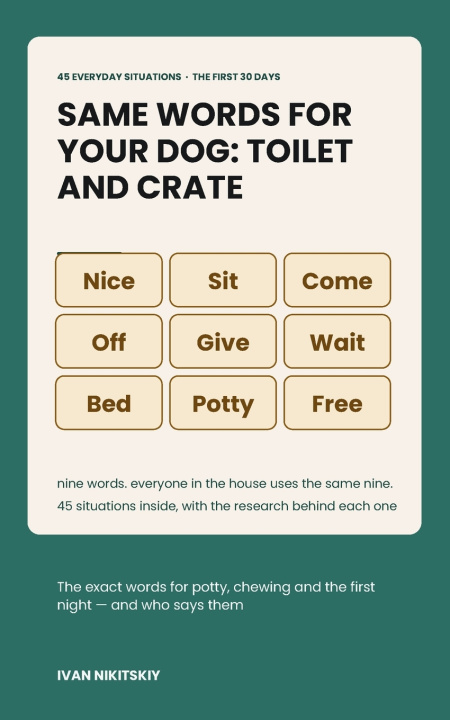
Every situation in this book names its source - a named study or a veterinary position statement, printed on the page, not a branded method and not a clip somebody shared.
This book does not tell you which breed to get or how to be the pack leader. It tells you what to say, what to do with your hands while you say it, and what you should be seeing a week later.
Forty-five situations from the first thirty days, each on one spread: the ride home, the first hour inside, where the crate goes, the first night and the crying that comes with it, the potty schedule and the accident you find twenty minutes late, teaching his name, puppy teeth on your hands, the chewing, following you from room to room, the barking at the window and at nothing, food on the table, the first word and the second one, what to pay with and how much, hands near the food bowl, getting something out of his mouth, jumping on people, being picked up, paws and ears and teeth, the collar and the leash indoors, the first walk, pulling, loud things, someone at the door, meeting other dogs and meeting people, puppy class, the first vet visit, what should be steady by day thirty, and what is still a mess and why that is fine.
Nine words, and everyone in the house uses the same nine. One word means one thing and never two. The list is printed at the front, and every spread says which of the nine it uses. Most of what goes wrong in a first month is two people in the same house saying two different words for the same thing.
The research behind every page is named. The American Veterinary Society of Animal Behavior on humane training, food guarding and socialization. The American Animal Hospital Association on handling, on the first visits, and on where a trainer stops and a behaviorist starts. Around them: Meghan Herron on what confrontational handling provokes, Alexandra Horowitz on the guilty look, Peter Pongracz on what barking is doing, Emily Blackwell on chewing and on loud things, Karen Overall on being alone, Erica Feuerbacher on what a puppy will work for, Frances Dale on the first sixteen weeks.
It also says where the evidence is thin. Several pages rest on studies that report an association and not a cause, and those pages say so. Where a source was funded by a company with something to sell, that is disclosed at the back with the company named. Two claims that other puppy books repeat are deliberately absent.
No brand of food, crate, collar or app is named anywhere in it. None of that changes what you say to a nine-week-old puppy.
Dominance is not the frame here, and the reason is on the page that says so.
Book one of Same Words for Dogs, and it stands alone.
Educational material. Not veterinary advice.