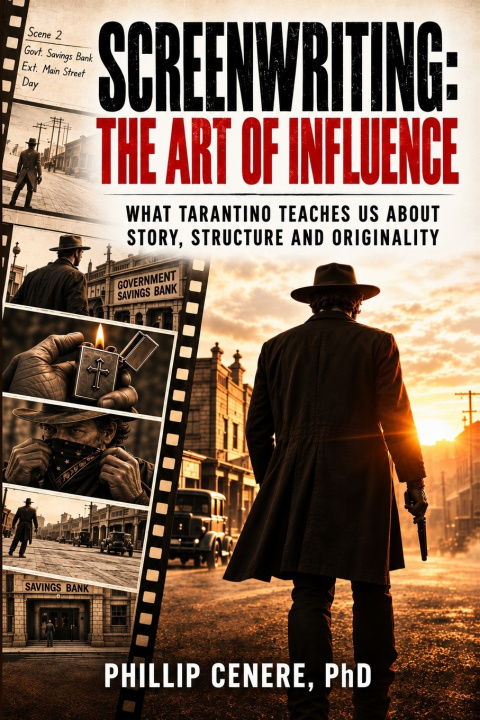
What do you actually take from a filmmaker you admire - and what do you owe the material in front of you?
Screenwriting: The Art of Influence is a study of cinematic influence written from the inside. It brings together two works submitted as a doctoral thesis at the University of Sydney: a critical exegesis and the full feature-length screenplay it accompanies, The Dust-Up at Broken Hill - a neo-western that opens with a bank robbery and a police shootout in 1930s outback New South Wales and moves eighty years forward to the robber's grandson, a half-deaf policeman working the same unforgiving country.
Part One takes Reservoir Dogs, Pulp Fiction and Kill Bill apart not as objects of homage but as machinery: nonlinear structure built around moral accountability rather than surprise, dialogue that conducts philosophy without announcing it, violence that carries a cost, music chosen for argument rather than mood. It asks what happens when those tools are carried into a different place, history and moral weight. It revisits Phillip Cenere's years as a critic of Australian cinema in the mid-2000s - seven of his Metro Magazine reviews are reproduced in full - and closes with a chapter-length critique of his own screenplay.
Part Two is the screenplay itself.
For screenwriters, film students and anyone who has wondered how influence becomes originality, this is the theory, the practice and an honest account of the distance between them, in one volume.