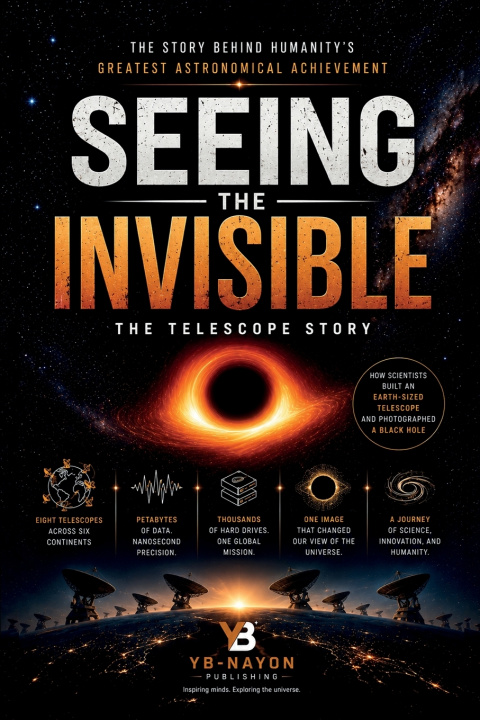
On April 10, 2019, six press conferences held simultaneously on four continents revealed a single photograph to the world. It showed a dark circle surrounded by a glowing ring of orange fire. It was blurry, asymmetric, and completely extraordinary. It was the first photograph of a black hole - taken by a telescope the size of the Earth.
This is the complete story of how that photograph was made.
Seeing the Invisible is the most comprehensive adult-level account of the Event Horizon Telescope project ever written. From the physics of why black holes are invisible to the engineering miracle of synchronizing eight telescopes across six continents, from the petabytes of data shipped on hard drives from the South Pole to the algorithms that turned radio signals into a historic image - every dimension of this extraordinary scientific achievement is explained in full depth.
What makes this book different from every other account:
Most popular books about black holes describe what black holes are. This book answers a completely different and equally fascinating question: How did human beings actually manage to photograph one? The answer involves a century of radio astronomy, extraordinary precision engineering, international scientific collaboration on an unprecedented scale, some of the most sophisticated mathematical algorithms ever applied to an astronomical problem.
Across fifteen deeply expanded chapters, you will understand:
Why a single telescope could never resolve a black hole shadow, and why the angular size of the M87 black hole is equivalent to seeing a golf ball on the surface of the Moon from Earth. The complete history of radio astronomy from Karl Jansky's accidental 1932 discovery of cosmic radio waves through the invention of very-long-baseline interferometry and its progressive extension to millimeter wavelengths. Why only two black holes in the entire observable universe, M87 and Sagittarius A*, are large enough and close enough to Earth for their shadows to be resolvable with an Earth-diameter baseline. How the EHT array was assembled from eight existing telescope sites at locations including the Atacama Desert in Chile, the summit of Mauna Kea in Hawaii, the Spanish Sierra Nevada, and the South Pole - and why each site was chosen. What the April 2017 eight-day observing campaign actually involved: nanosecond synchronization with hydrogen maser atomic clocks, data recorded at 32 gigabits per second, five petabytes of raw data too large to transmit over any internet connection and shipped physically on hard drives across the world. The four independent imaging teams and the algorithms they used, including the CHIRP method developed by Katie Bouman as part of her MIT doctoral research, why four independent approaches were required before any image was accepted as reliable. What the final M87 image actually shows: the photon ring shadow as evidence of the event horizon, the brightness asymmetry as evidence of Doppler boosting from the orbiting accretion plasma, and the precise measurement of the black hole mass from the shadow angular diameter. How the Sagittarius A* image, released three years later in 2022, required completely new imaging algorithms to handle the rapid variability of a source whose accretion flow changes on timescales of only minutes. The polarimetric observations that revealed the magnetic field structure near M87's event horizon for the first time,
No prior background in radio astronomy or physics is required, but no important idea is simplified beyond recognition. The Rayleigh criterion, closure phases, GRMHD simulations, the Fourier plane, aperture synthesis, interstellar scattering - all are explained from first principles, with the depth and precision that this landmark achievement deserves.
If you want to understand not just that a black hole was photographed but exactly how - this is the definitive book.