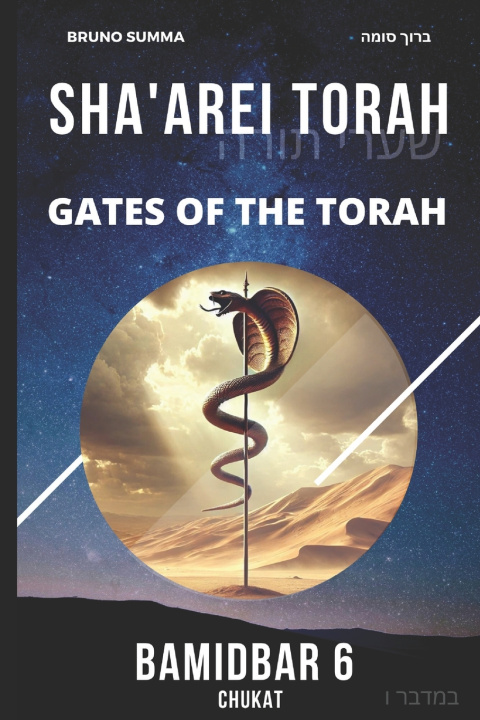
The Sefer Bamidbar, or Book of Numbers, is the most relevant and ethical of all five books that make up the Torah. It recounts little-known and rarely taught stories, stories in which we see praiseworthy and reprehensible attitudes and behaviors that are intrinsically found within every human being, whether righteous or not. One of the main themes of Bamidbar is the human ethics taught by the Torah, by which everyone can truly lead a life of constant Avodat Hashem.
This work does not aim to address the Book of Numbers literally, nor to elucidate its accounts, but rather, through great sages, the Talmud, and the Zohar, to present an interpretation that goes beyond the usual. Facing head-on the simple understanding that is conveyed through a simple reading is the true key to success in learning the Torah. One of the main factors that inspired this work is the scarcity of teachings on the Book of Numbers. Much of the literature discussed here, such as the commentaries of the greatest sages, has never been translated and is found only in Hebrew, as are the Talmud and the Zohar, which are found mostly only in Aramaic. These sources of inspiration, which are very well preserved and whose teachings are closely guarded, will be the basis for everything that will be discussed throughout this work.
The way this book was composed follows the midrashic form of biblical teaching, which seeks to teach the Torah through explanations and teachings based on verses contained in the parashot. Due to the fact that there are few works that address the contents and themes contained in this book in Western languages, this work aims to expand the knowledge of the Torah to those who have limited access to a deep understanding of the Divine Word due to language barriers.
Sha'arei Torah, Gates of Torah - Bamidbar 6 elucidates the divine words of the Book of Numbers in a mystical and spiritual way, always returning its teachings to the human behavioral side. This work follows the rabbinical form of elucidating the Chumash. Comments on the verses of Parashat Chukat will be presented.
WARNING
THIS BOOK HAS NOT BEEN ORIGINALLY WRITTEN IN ENGLISH AND A NON-NATIVE ENGLISH SPEAKER HAS TRANSLATED IT. THUS IT STILL CONTAINS GRAMMATICAL ERRORS, AS WELL AS SPELL ERRORS AND IT COULD BE UNCLEAR IN SOME PARTS.