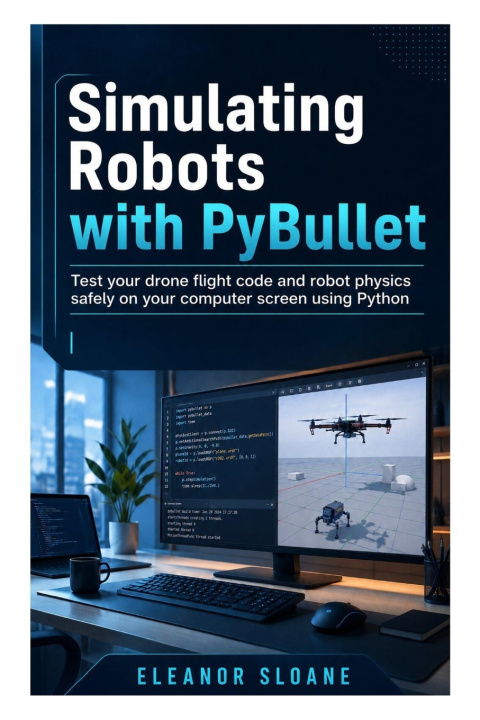
Build, Control, and Test Virtual Robots Before Risking Real Hardware
A robot may look stable on a computer screen while quietly exceeding a joint limit, applying unrealistic forces, drifting away from its target, touching an obstacle, or landing too quickly.
Useful simulation requires more than attractive animation. You must define what the experiment is supposed to prove, use appropriate physical parameters, measure the robot's state, record the results, and compare its behaviour with clear pass-and-failure criteria.
Simulating Robots with PyBullet provides a practical introduction to testing robot movement, drone-control logic, collisions, sensors, cameras, feedback controllers, and complete missions with Python.
Written for beginners with basic Python knowledge and intermediate programmers entering robotics simulation, the book uses PyBullet to create controlled virtual environments for wheeled robots, articulated arms, and a simplified quadrotor. Every core exercise runs on a computer, so no physical robot, electronics construction, advanced calculus, or ROS installation is required.
Inside this project-based guide, you will learn how to:
- Understand what physics simulation can and cannot prove
- Distinguish simulation from animation and data visualisation
- Define a clear experimental question before building a virtual world
- Record assumptions, variables, measurements, and acceptance limits
- Create repeatable experiments with controlled starting conditions
- Install Python, PyBullet, NumPy, Matplotlib, and testing tools
- Use isolated virtual environments and reproducible dependency files
- Work in graphical and headless execution modes
- Connect to and disconnect from the PyBullet physics server safely
- Configure gravity, time steps, asset paths, and simulation state
- Load static and dynamic rigid bodies
- Read position, orientation, linear velocity, and angular velocity
- Detect ground contact and record numerical results
- Use consistent SI units throughout a simulation
- Configure mass, inertia, centre of mass, friction, restitution, and damping
- Select stable physics and controller update rates
The book maintains a clear boundary between virtual evidence and real-world safety. It explains that simulation cannot guarantee exact motor performance, sensor behaviour, battery condition, manufacturing quality, or aerodynamic accuracy. Any transfer to physical hardware must repeat checks for motor direction, sensor axes, controller gains, stopping distance, timeouts, emergency shutdown, hover thrust, and landing behaviour.
Supporting resources include an installation and compatibility checklist, version-verification record, coordinate-frame reference, SI-unit table, quaternion conventions, wheel-speed and differential-drive formulas, hover-thrust calculations, PID equations, time-step relationships, and a robotics glossary.
Whether you are a Python learner, robotics student, educator, drone developer, hobbyist, control-systems beginner, or programmer preparing algorithms for later hardware testing, this guide will help you turn a moving virtual model into a measurable engineering experiment.
Define the question. Build only the model required. Measure every result. Automate the acceptance test. Treat a passing simulation as evidence-not proof of hardware safety.