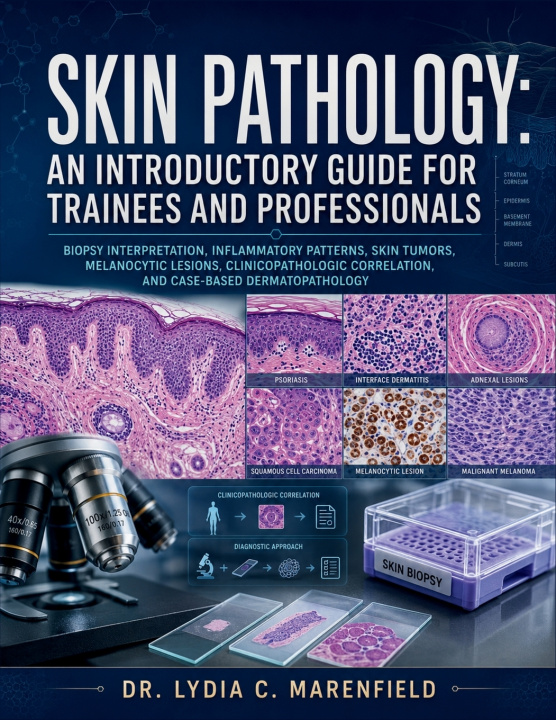
Skin pathology is a visually rich and diagnostically important area of medicine, helping clinicians and pathologists understand inflammatory diseases, infections, benign lesions, premalignant changes, cutaneous tumors, melanocytic proliferations, and disorders affecting the epidermis, dermis, adnexa, and subcutaneous tissue.
This guide has been created for readers who want a clear, structured, and approachable introduction to diagnostic skin pathology.
Written in a professional but learner-friendly style, it explains how skin biopsies are approached, how microscopic patterns are recognised, and how pathologic findings are interpreted alongside clinical history, lesion appearance, biopsy site, and differential diagnosis.
Readers will explore normal skin anatomy, biopsy types, specimen handling, inflammatory reaction patterns, interface dermatitis, spongiotic dermatitis, psoriasiform patterns, vesiculobullous disorders, granulomatous inflammation, infectious processes, adnexal lesions, keratinocytic tumors, melanocytic lesions, soft tissue findings, and selected case-based examples.
The book also introduces practical principles of histologic description, special stains, immunohistochemistry awareness, reporting structure, diagnostic pitfalls, communication with clinicians, and the importance of clinicopathologic correlation in skin disease diagnosis.
The focus is on helping learners understand what they are seeing under the microscope, why particular findings matter, how patterns are grouped, and how diagnostic reasoning develops from tissue appearance to meaningful interpretation.
Whether used by medical students, pathology residents, dermatology trainees, histopathology learners, laboratory professionals, physician associates, nurse practitioners, or clinicians seeking a clearer foundation in dermatopathology, this guide provides a practical starting point for understanding skin disease through pathology.
This book is intended for educational use only and does not replace specialist dermatopathology reporting, supervised diagnostic training, dermatology consultation, institutional laboratory protocols, current diagnostic criteria, or professional medical judgement.