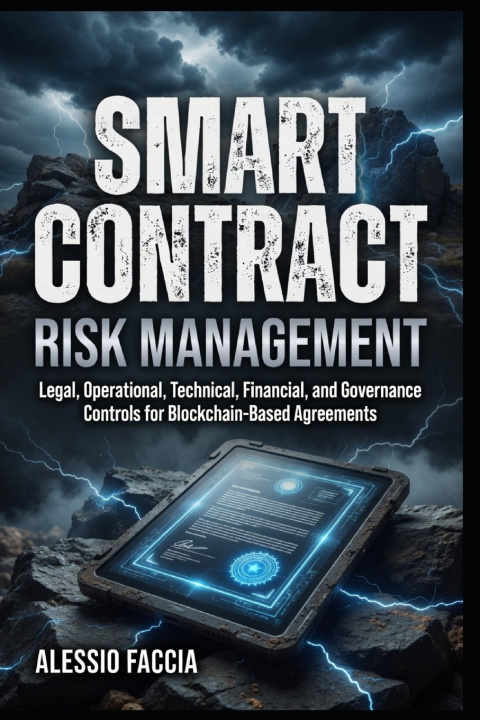
Smart Contract Risk Management is a professional guide for executives, auditors, finance teams, lawyers, compliance officers, blockchain developers, and digital asset managers who need to understand the risks behind blockchain-based agreements.
Smart contracts promise automation, speed, traceability, and lower transaction friction. They also create serious exposure when legal terms, code logic, private keys, oracle data, financial records, governance powers, and regulatory duties do not align. A transaction may execute correctly on-chain while creating legal disputes, accounting errors, liquidity stress, cyber losses, customer harm, or regulatory breaches.
This book provides a structured framework for identifying, assessing, controlling, and reporting smart contract risk. It explains how code-based execution interacts with written agreements, contractual authority, consumer and investor protection, AML controls, sanctions screening, wallet governance, technical audits, formal verification, incident response, custody arrangements, tokenised finance, and board oversight.
The discussion covers the full smart contract lifecycle, from design and coding to testing, deployment, monitoring, upgrades, incident response, and termination. It examines common technical risks such as logic failures, re-entrancy, integer issues, oracle failure, private key compromise, front-end attacks, blockchain network dependence, and cross-chain execution. It also explains financial reporting, valuation, liquidity risk, counterparty exposure, treasury management, insurance, capital planning, loss allocation, audit trails, evidence collection, and management reporting.
Smart Contract Risk Management treats smart contracts as enterprise control systems, not as isolated software scripts. It shows why effective smart contract governance requires legal clarity, secure engineering, reliable data, strong cyber controls, clear documentation, board-approved risk appetite, tested incident playbooks, and continuous monitoring.
Readers will find practical guidance on:
• Designing smart contracts with clear legal and business logic
• Mapping written agreements to executable code
• Managing wallets, private keys, access rights, and custody risk
• Assessing audits, formal verification, penetration testing, and bug bounty programmes
• Building KYC, AML, sanctions, Travel Rule, and on-chain compliance controls
• Preparing for incidents, emergency pauses, rollback limits, and recovery
• Connecting smart contracts with accounting, valuation, liquidity, and treasury controls
• Reporting smart contract risk to boards, auditors, regulators, and senior management
• Assessing future risks from AI-generated contracts, tokenised finance, and cross-chain systems
This book is designed for professionals who need a practical, rigorous, and business-focused approach to smart contract risk. It avoids hype and focuses on control. It helps readers ask the right questions before smart contracts move assets, create rights, automate payments, or expose organisations to avoidable losses.