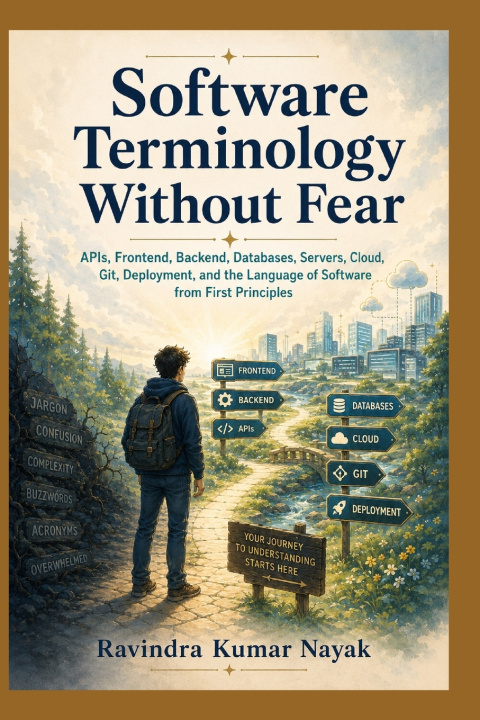
Software words should not feel like a locked room.
If you have ever sat in a product meeting, opened a technical document, listened to developers discuss an app, or tried to understand how websites work, you may have felt the same quiet frustration: every sentence contains another unfamiliar word.
Frontend. Backend. Server. Client. API. Request. Response. Database. SQL. NoSQL. Git. GitHub. Deployment. Cloud. Container. Authentication. Authorization. Scalability. Maintenance.
The words arrive quickly, but the meaning often arrives too late.
Software Terminology Without Fear is written for non-technical readers who want to understand the language of software development without pretending, panicking, or memorizing empty definitions. It does not assume coding experience. It begins from first principles: why each term exists, what repeated problem it names, where it appears in real software work, and how it connects to the rest of the system.
This book treats software as organized human work. A program becomes a set of steps. Code becomes written instruction. Syntax becomes grammar. A frontend becomes what users see. A backend becomes the hidden work behind the screen. An API becomes a clear door between systems. A database becomes software memory. Git becomes a way to track change. Deployment becomes the moment software goes where real use can happen.
Through calm explanations, layered mental models, practical translation rooms, visual learning pages, and gentle dialogues, the book helps readers slow down technical sentences and rebuild them in plain meaning. Instead of hearing a sentence like, "The frontend sends an API request to the backend, which queries the database and returns a response," as one frightening block, the reader learns to see a sequence of simple roles: the visible app asks, the hidden system works, stored information is checked, and an answer returns.
Inside, readers will build confidence with software vocabulary used in everyday technology conversations: apps and programs, source code and runtime, frontend and backend, client and server, APIs and endpoints, requests and responses, databases and queries, frameworks and libraries, packages and dependencies, testing and debugging, Git and GitHub, deployment and cloud, containers and environments, authentication and authorization, performance and scalability, incidents and maintenance.
The final Value Edition goes beyond vocabulary. It gives the reader a method for thinking: scratch-layer revision, problem chunking, meeting translation, no-fear mathematics, and brain-training exercises that help the mind organize complexity without being overwhelmed.
This is not a coding manual. It is not a dictionary. It is a first-principles bridge for students, founders, product managers, designers, business owners, marketers, support teams, career changers, curious professionals, and anyone who wants to join software conversations with more clarity.
If you want to understand software language from the ground up, this book gives you a calm path: one term, one reason, one connection, one layer at a time.