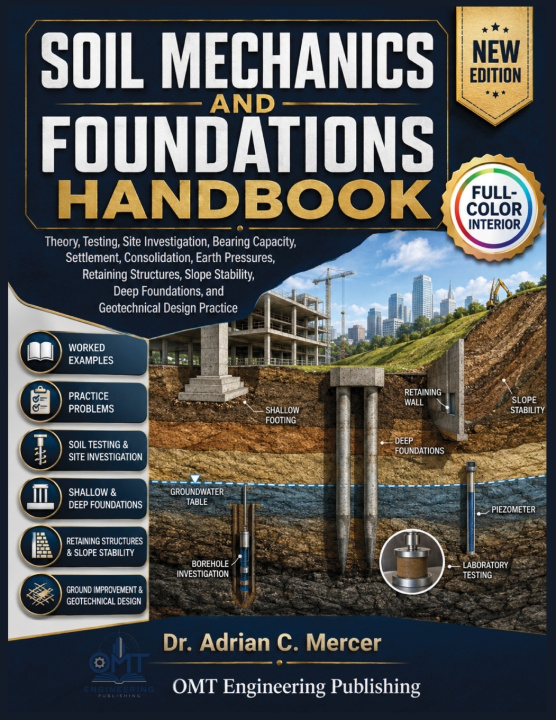
Build a clear and practical understanding of soil behaviour, foundation design, and modern geotechnical engineering.
Soil Mechanics and Foundations Handbook is a detailed engineering reference for students, lecturers, technicians, civil engineers, and practising geotechnical professionals. It explains how soils form, how they are classified and tested, how water and stress affect their behaviour, and how these principles are applied to safe foundation and earth-structure design.
The book begins with soil origin, mineralogy, phase relationships, index properties, and soil classification. It then develops the main principles of effective stress, groundwater flow, seepage, compaction, consolidation, settlement, shear strength, and critical-state behaviour. Each topic is explained in simple technical language, with clear equations, full calculations, worked examples, practice problems, and answer checks.
Readers will learn how to plan site investigations, interpret borehole and field-test data, create ground models, select design parameters, and prepare geotechnical reports. The chapters connect laboratory testing with real engineering decisions, helping readers understand not only how to calculate an answer, but also when an equation is suitable and what assumptions must be checked.
The foundation engineering sections cover shallow foundations, bearing capacity, immediate and long-term settlement, eccentric loading, limit-state design, piles, drilled shafts, micropiles, helical foundations, pile groups, and piled rafts. Construction methods, load testing, integrity testing, downdrag, lateral loading, and foundation quality control are also explained.
The handbook also provides practical coverage of:
- Soil classification and laboratory testing
- Site investigation and geotechnical reporting
- Groundwater, permeability, seepage, dewatering, and filters
- Effective stress, consolidation, creep, and settlement
- Shear strength, stress paths, and critical-state interpretation
- Shallow and deep foundation design
- Piles, drilled shafts, micropiles, and piled rafts
- Earth pressures, retaining walls, and braced excavations
- Reinforced soil, soil nails, anchors, and support systems
- Slope stability, landslides, and stabilisation
- Earthquake geotechnics, cyclic loading, and liquefaction
- Expansive, collapsible, organic, tropical, and frozen soils
- Geosynthetics and ground-improvement methods
- Numerical modelling, reliability, monitoring, and digital ground models
- Sustainable geotechnical design and professional practice
The worked examples show every calculation step and keep units visible throughout. Practice problems allow readers to apply the methods independently, while the appendices provide formula references, typical soil-property ranges, test-selection guidance, design checklists, selected answers, a glossary, and a subject index.
This book can be used as a geotechnical engineering textbook, a foundation engineering handbook, or a civil engineering reference manual. It supports university study, design-office calculations, site work, professional development, and technical review.
Soil Mechanics and Foundations Handbook gives readers the theory, testing methods, design procedures, and practical judgement needed to understand the ground and make better engineering decisions.