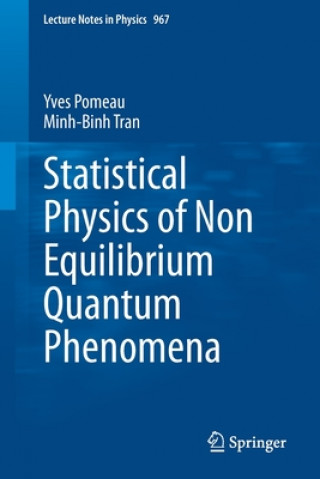
Könyv Statistical Physics of Non Equilibrium Quantum Phenomena Yves Pomeau

Statistical Physics of Non Equilibrium Quantum Phenomena

Nyelv: Angol
Kötés: Puha kötésű
Elérhetőség: Beszállítói készleten
Küldés 8-11 napon belül
21 723 Ft
The transition from Newtonian mechanics to quantum mechanics in the early years of the twentieth cen...


Információk a könyvről

Nyelv
Angol
Kötés
Könyv - Puha kötésű
Kiadva
2019
oldal
227
EAN
9783030343934
Enbook ID
24840317
Súly
454
Méretek
155 x 235 x 14

Teljes leírás

The transition from Newtonian mechanics to quantum mechanics in the early years of the twentieth century has been a major step in the progress of our understanding of the world. This transition was more than a change of equations because it involved also a deep change in our understanding of the limits of human knowledge. It included from the very beginning a statistical interpretation of the theory. Originally statistical concepts were introduced to describe classically (not with quantum theory) complex systems with many degrees of freedom like a volume of fluid including a very large number of molecules. These large systems cannot be fully described and/or predicted since no human being has enough computational power to solve Newton's equations with the initial data (position and velocity) of too many particles. In classical mechanics, another point makes difficult to predict distant future from the initial data. This problem occurs when a small disturbance or inaccuracy in the initial conditions is amplified in the course of time, a character linked to what is called the ergodicity properties of dynamical systems, which is very hard to prove for given systems. In these examples (many particles and/or ergodicity of classical dynamics) the statistical method of analysis is just a way to describe systems given the imperfect knowledge of the initial conditions and their overwhelming abundance. In the limit of a dilute gas, Boltzmann found the right theory for describing the evolution of a large number of particles interacting by short range two-body forces. In this theory, kinetic equations are a primary tool. Kinetic equations modelise systems made up of a large number of particles (gases, plasma, etc.) by a distribution function in the phase space of particles, based on the modeling assumption that there are so many particles that the whole system can be treated as a continuum. In the first part of this book, we introduce a kinetic equation, of the Kolmogorov type, necessary to describe the situation, in which an isolated atom (actually an ion in the experiments) under both the effect of a classical pumping EM field which keeps it in the excited state(s) together with the random emission of fluorescence photons putting back this atom in its ground state. The quantum kinetic theory developed in the second part of this book is the extension of Boltzmann classical (non-quantum) kinetic theory of a dilute gas of quantum bosons. This is the source of many interesting fundamental questions, particularly because, if the temperature is low enough such a gas is known to have at equilibrium a transition, the Bose-Einstein transition, where a finite portion of the particles stay in the quantum ground state. This book provides an introduction to these systems for both mathematicians and theoretical physicists who are interested in the topic.

Érdekelheti

Letters for Lucardo

Noora Heikkila
4 702 Ft

Vindolanda

Adrian Goldsworthy
4 454 Ft
8 545 Ft
63 014 Ft
3 770 Ft
12 535 Ft

Bicycle Boosters

Will Du Toit
3 930 Ft

Paul Klee

Paul Klee
18 926 Ft

Everlasting Man

Gk Chesterton
8 081 Ft

Azok a vásárlók, akik ezt a könyvet megvásárolták, a következőket is megvásárolták

1 295 Ft
6 566 Ft

Höhere Gewalt

Renee R Picard
5 648 Ft

Pinocchio

Carlo Collodi
2 709 Ft

Interiors

Quicksand
6 800 Ft

Anie

Hector Malot
9 408 Ft

Gospoda Bovari

Gistav Flober
10 221 Ft