Könyv Strategic and Operational Decision-Making Corey A Givens

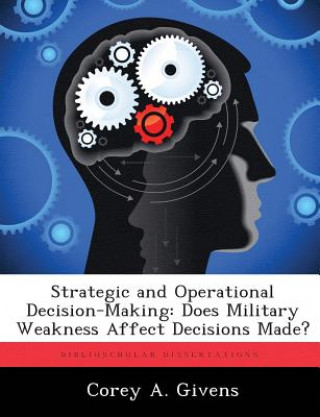
Strategic and Operational Decision-Making

Does Military Weakness Affect Decisions Made?

Szerző: Corey A Givens
Nyelv: Angol
Kötés: Puha kötésű
Kiadó: Biblioscholar
Elérhetőség: Beszállítói készleten
Küldés 14-21 napon belül
6 137 Ft
The United States and Japan had a very contentious relationship between 1939 and 1941. During this t...
Információk a könyvről

Szerző
Nyelv
Angol
Kötés
Könyv - Puha kötésű
Kiadva
2012
oldal
56
EAN
9781288322473
ISBN
9781288322473
Enbook ID
08243550
Kiadó
Súly
118
Méretek
189 x 246 x 3

Teljes leírás

The United States and Japan had a very contentious relationship between 1939 and 1941. During this time, Japan's strategic objectives focused on the desire for a policy of national self-sufficiency and of non-reliance on Western imports or economic aid. Its major operational objective was the Dutch East Indies, where Japan imported its oil, rubber, and a number of other goods. Japan fully pursued its objectives as the armed forces provided the foundation for plans to identify, protect, modernize, and expand its national interests. Conversely, the weakness of the United States' military restricted its strategic and operational objectives. One of the strategic objectives for the United States was to uphold the principles of the Open Door in East Asia. However, the United States was unable to embark upon punitive measures to protest Japan's seizure and economic assimilation of Manchuria. America's key operational objective was maintenance of the Philippines, a place from which the United States could project its power. For state actors, keeping the elements of national power, or Diplomacy, Information, Military, and Economy (DIME) in alignment is significant for national stability. An analysis of America's DIME construct reveals how the weakness of the United States' military forced it to rely on the Diplomatic and Economic elements of national power, and this negatively affected the way the United States conducted its strategic and operational decision-making with imperial Japan from 1939-1941. Diplomatically, American policy intended to uphold the Open Door Policy in the Far East; however, its foreign policy was weak because it did not have the necessary military might to back its demands. Therefore, the United States resorted to economic pressure. It implemented a policy of escalating deterrence in an effort to stop Japanese expansion. The economic pressure became too much when the United States deprived Japan of oil, which was a major commodity that the Japanese c

Érdekelheti

Every Child Can Learn

Marie L Greenwood
6 051 Ft

Complete Short Stories

James Graham Ballard
7 416 Ft

The Protege

Kailin Gow
4 853 Ft
6 209 Ft
6 150 Ft
11 744 Ft

How Firms Make Friends

Matthias Stürmer
18 123 Ft
10 163 Ft

Azok a vásárlók, akik ezt a könyvet megvásárolták, a következőket is megvásárolták

20 116 Ft

To si vypiješ!

Petr Štengl
1 836 Ft