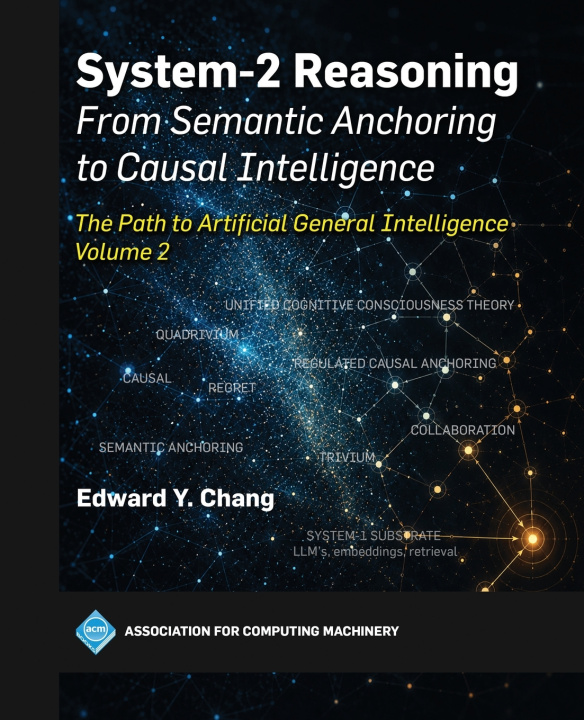
Large language models can write poetry, pass bar exams, and generate fluent code. Yet they continue to fail in the domains where intelligence must be accountable: distinguishing causation from correlation, recognizing when evidence is insufficient, preserving commitments over time,and correcting their own reasoning failures. This book argues that the transition from pattern matching to genuine reasoning requires a System-2 layer grounded in coordinated diagnosis, audit, causal validation, memory, and meta-cognitive control.
The volume develops this architecture from first principles through operational protocols. Semantic Anchoring (UCCT) demonstrates how contextual constraints can bind latent model representations into governed reasoning processes rather than prior-driven completion. Regulated Causal Anchoring (RCA) and RAudit diagnose sycophancy, pathological skepticism, and trace-output inconsistency without relying exclusively on ground-truth supervision. The Causal Abstraction Bridge and the CausalTSK benchmark reveal where models collapse from interventional and counterfactual reasoning back into associative prediction.
Epistemic Regret Minimization (ERM) identifies causal shortcuts and failures of warranted inference, while Reinforcement Learning from Epistemic Regret (RLER) transforms those reasoning failures into a structured learning signal. Trivium introduces temporal accountability through a Causal Transaction Log, and Quadrivium integrates contextual, causal, temporal, and meta-cognitive regulation into a unified System-2 MACI architecture.
The author's central thesis is that Artificial General Intelligence (AGI) will not emerge from scaling monolithic pattern-completion systems alone. AGI will require architectures capable of explaining why an answer is warranted, refusing conclusions when evidence remains indeterminate, and improving through epistemic failure.
Written for researchers, advanced students, and practitioners, this book presents a framework for AI systems that are not merely impressive, but auditable, corrigible, and trustworthy. It is suitable for graduate-level courses in artificial intelligence, multi-agent systems, causal reasoning, and trustworthy AI.