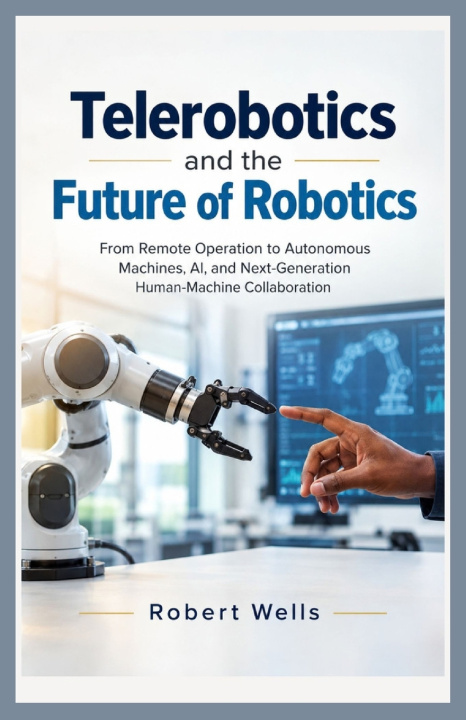
Telerobotics and the Future of Robotics
From Remote Operation to Autonomous Machines, AI, and Next-Generation Human-Machine Collaboration
Robots are moving beyond controlled factory environments and becoming increasingly capable of operating alongside humans, working in hazardous locations, exploring distant environments, assisting professionals, and performing tasks that once required direct human presence.
Telerobotics and the Future of Robotics provides a comprehensive introduction to the technologies, principles, applications, and emerging developments shaping this transformation.
Beginning with the foundations of robotics and remote operation, this book explains how telerobotic systems allow humans to control, supervise, and collaborate with machines across physical distances. It explores the relationship between human operators and robotic systems, including sensors, actuators, communication networks, robotic perception, control systems, telepresence, and human-machine interfaces.
The book then examines the evolution from direct teleoperation toward increasingly autonomous machines. It explains how artificial intelligence, machine learning, computer vision, navigation, sensor fusion, robotic learning, and decision-making systems are changing what robots can accomplish without continuous human intervention.
Readers will also explore the growing importance of human-robot collaboration and shared control. Rather than treating humans and machines as competing forces, the book examines how human judgment, experience, creativity, and contextual understanding can complement the precision, endurance, sensing capabilities, and computational power of robotic systems.
Practical applications are examined across a wide range of fields, including:
- Medical and surgical robotics
- Space exploration
- Underwater robotics
- Manufacturing and industrial automation
- Disaster response and search and rescue
- Agriculture and mining
- Logistics and warehousing
- Hazardous-environment operations
- Service and collaborative robotics
Beyond applications, the book addresses the issues that will increasingly determine whether advanced robotic systems can be deployed responsibly. It examines robotic safety, reliability, cybersecurity, privacy, human oversight, ethical considerations, and the challenges associated with autonomous decision-making.
The final chapters look toward emerging technologies such as humanoid robots, soft robotics, swarm robotics, digital twins, cloud and edge robotics, advanced haptic interfaces, embodied artificial intelligence, and increasingly sophisticated human-machine collaboration.
Whether you are a student, technology enthusiast, robotics learner, researcher, professional, or simply interested in understanding where robotics is heading, this book provides a structured and accessible examination of the field-from the fundamentals of remote operation to the possibilities of intelligent autonomous machines.
The future of robotics is not only about machines becoming more capable. It is about discovering how humans and machines can work together more effectively.