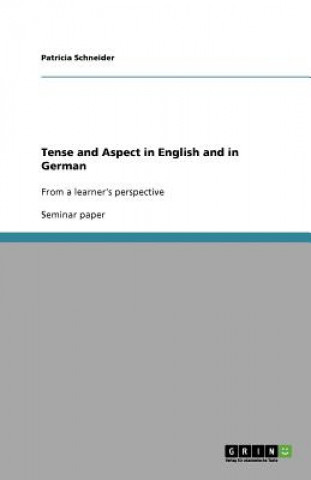
Könyv Tense and Aspect in English and in German Patricia Schneider

Tense and Aspect in English and in German

From a learner's perspective

Nyelv: Angol
Kötés: Puha kötésű
Kiadó: Grin Verlag
Elérhetőség: Beszállítói készleten
Küldés 8-11 napon belül
5 619 Ft
Seminar paper from the year 2009 in the subject English - Pedagogy, Didactics, Literature Studies, g...

Információk a könyvről

Nyelv
Angol
Kötés
Könyv - Puha kötésű
Kiadva
2010
oldal
40
EAN
9783640727568
ISBN
3640727568
Enbook ID
05280202
Kiadó
Súly
59
Méretek
140 x 216 x 3

Teljes leírás

Seminar paper from the year 2009 in the subject English - Pedagogy, Didactics, Literature Studies, grade: 1,3, University of Freiburg (Englisches Seminar), course: Proseminar I: Contrastive Linguistics, language: English, abstract: As English and German are both Germanic languages they are closely related. However, there are still a lot of differences to be found when comparing the two languages. This is among other things due to the fact that English and German represent different language types. Among the grammatical categories relating to which the two languages can be analysed, tense and aspect are certainly salient. Before starting to analyse both languages with regard to these categories, the difference between tense and aspect has to be clarified. Tense is both a deictic and a relational category. Therefore it locates an event on the time line usually with reference to the time of speaking. Aspect, by contrast, does not locate an event or situation on the time line nor does it relate the time of one situation to another. It is rather concerned with the internal temporal constituency of one situation . This term paper will examine how English and German differ in their use and expression of tense and aspect taking the perspective of a learner. First the three stages of tense and aspect acquisition by learners will be described in general terms. Particular attention will be paid to the influence of instruction on the learners. Then this term paper will examine how English and German differ in their use of tense. This will be illustrated on the example of the different uses of the perfect. Afterwards the focus will be on aspect. While English uses the progressive to indicate a change of aspect, there is no such formal equivalent in the German language. Therefore German learners of English are confronted with the question of how to express this internal constituency of one situation in their mother tongue. Various devices that are used by German learners of English to express the progressive will be exemplified. Both the section on tense and the section on the progressive will conclude with a focus on the difficulties for and the typical errors made by the learners. However, as there is no material available concerning English learners of German, only the German learners of English will be taken into account.

Érdekelheti

American Art Book

Phaidon Editors
23 439 Ft
23 128 Ft

Nano-Optics

Satoshi Kawata
59 702 Ft

Faith Examined

Clark R. Bates
13 139 Ft
7 692 Ft

Ninety-Eight

Arthur David Maccormick
10 138 Ft

Franz Schubert

Franz Schubert
9 947 Ft
20 581 Ft
93 470 Ft

Azok a vásárlók, akik ezt a könyvet megvásárolták, a következőket is megvásárolták

3 605 Ft
5 489 Ft
6 987 Ft

Surrender

Charlotte Breuer
10 564 Ft
53 982 Ft
12 402 Ft

La 8ème Habitude

Stephen M. R. Covey
10 871 Ft

Und der Igel schwimmt doch!

Ludwig van Beethoven
5 707 Ft
15 139 Ft

de Dnde Sale La Ropa?

Chris Butterworth
6 120 Ft
5 224 Ft

Veränderungsprozesse

Daniel N. Stern
10 430 Ft