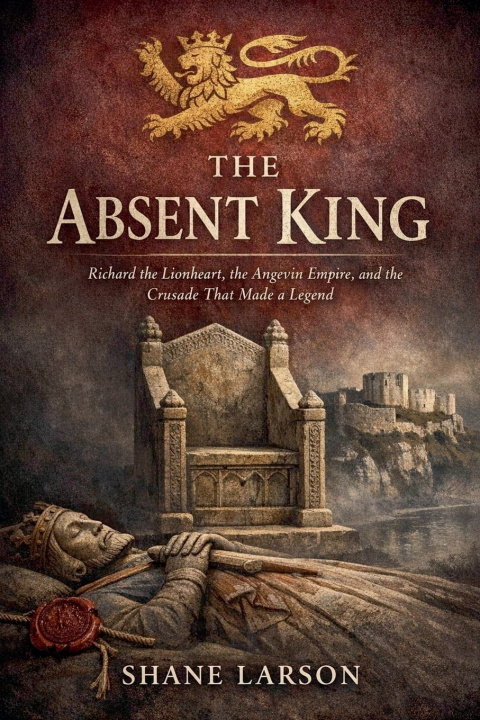
England's most famous medieval king spent about six months of a ten-year reign in England, and he is not recorded as having spoken English.
Richard I was born at Oxford in 1157 and raised in his mother's Aquitaine. He was a duke at fourteen, in arms against his father at fifteen, and for the next fifteen years he took castles from barons who rose every second spring. When England came to him in 1189 he spent four months turning it into cash: offices and sheriffdoms sold, the overlordship of Scotland sold back, a fleet of more than a hundred ships bought and provisioned. Then he sailed. He ended a two-year siege at Acre in five weeks, won at Arsuf, came within twelve miles of Jerusalem twice and turned back both times, on purpose. Captured near Vienna on the way home, he cost England 150,000 marks of silver, raised by a quarter on everyone's movable goods. He came back for two months, crossed to Normandy, and spent five years winning back from Philip of France what had been lost in his absence. In April 1199, aged forty-one, he died of a crossbow wound taken beneath a castle that was barely defended.
He was the best field commander of his century, and this book says so. It also says that at Acre in August 1191 he had about 2,700 bound prisoners led onto the plain and killed in sight of Saladin's army because a ransom was overdue and he wanted to march, and that his coronation set off attacks on England's Jews that ended at York the following spring. Both things are true. Neither cancels the other.
Every scene names its witness: Roger of Howden, the clerk who sailed with him; Ambroise, the jongleur who marched in his army; Baha al-Din, the judge in Saladin's household who watched the same battles from the other side of the line. No chronicle is quoted and none is taken on trust; the reader always knows whose account is in play and which way he leaned.
What you'll learn:
- Why a king of England would sell the overlordship of Scotland and spend it on biscuit, horseshoes and ships
- How an army marched down a hostile coast with its fleet in step and its infantry screen tight, and why Arsuf is still a textbook case
- What the Christian and Muslim accounts of the Acre killings agree on, where they differ, and what historians argue about the motive
- Why the council at Beit Nuba turned back from Jerusalem, and whether that was judgement or failure
- What 150,000 marks meant in years of crown revenue, and how a kingdom paid it with its king in a German prison
- Why Château Gaillard cost more than every castle Richard built in England, and what it was for
- Where Blondel, Robin Hood and the Westminster statue came from, and how little of the man survives in them
This book is for you if:
- You know Richard from the end of a Robin Hood story and want to know what he was doing for those ten years
- You read military history and want the march, the siege and the fortress treated as problems a commander had to solve
- You have read the Crusades from the top down and want one campaign from inside the camp
- You want the atrocities and the victories in the same ledger, with the sources named and the verdict left to you
A French prince who inherited England and spent its silver on wars elsewhere. The statue outside Parliament shows him arriving. He never did.